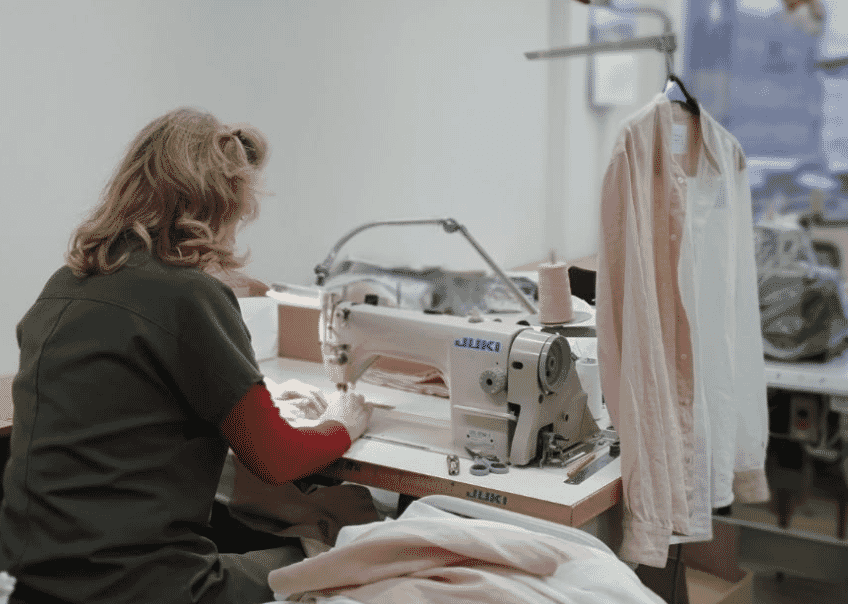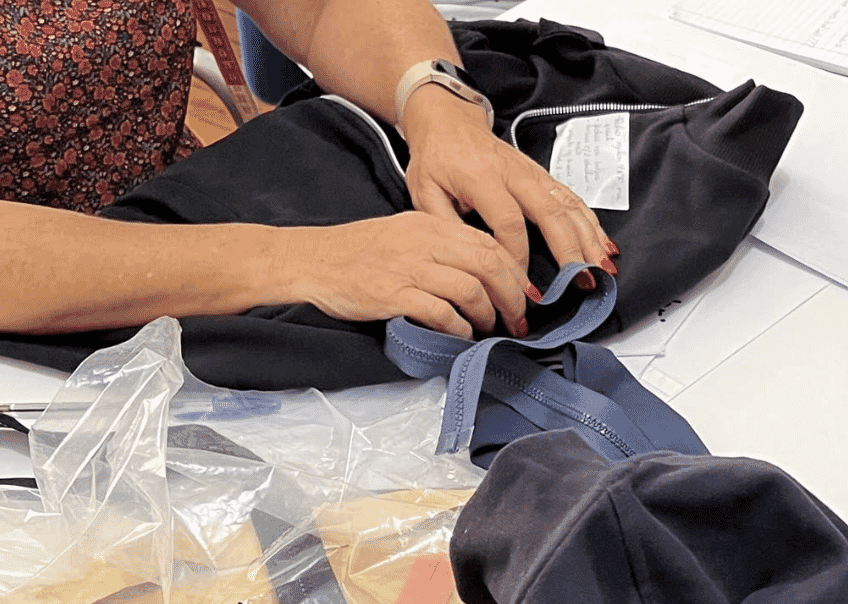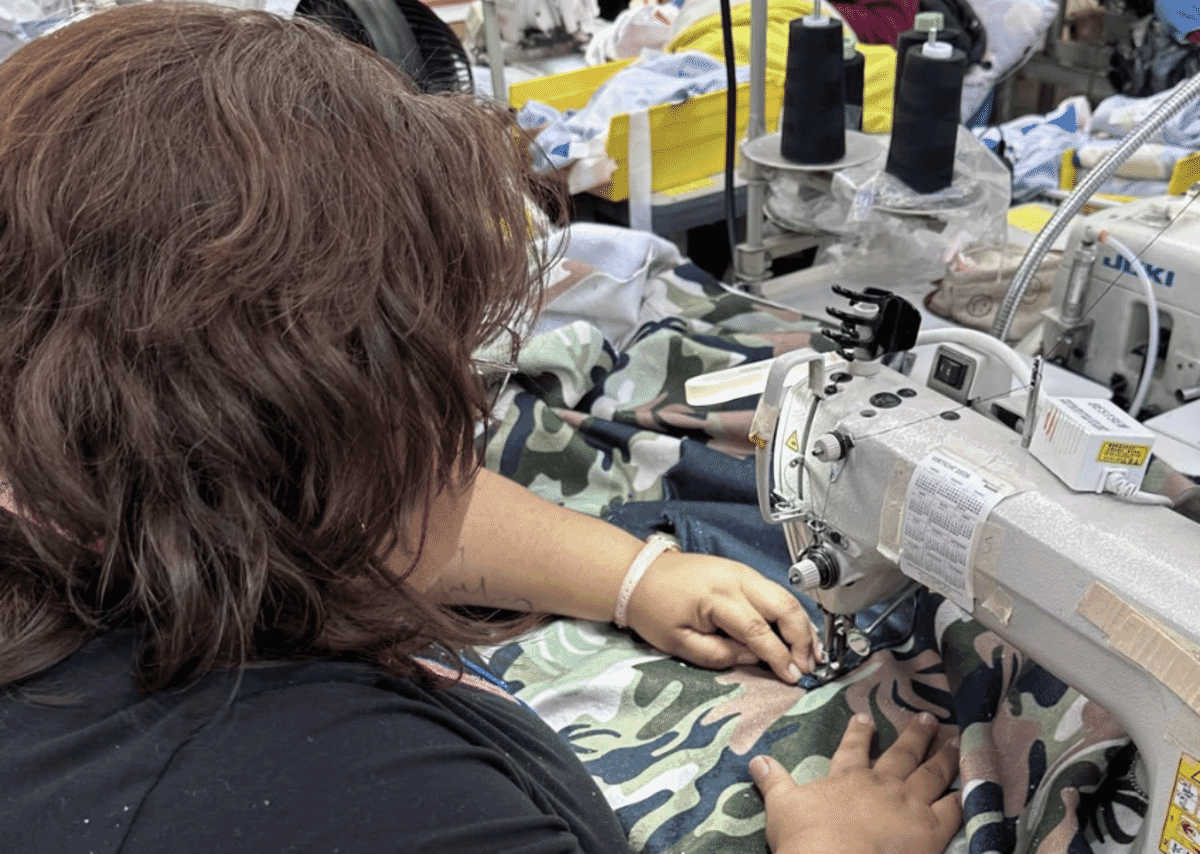
Clothing manufacturers in Leicester are the largest concentration of garment production left in Britain, and the hardest subject in the industry to write about honestly. Any page that lists Leicester factories without acknowledging why the city is scrutinised is selling you something. Any page that treats the scrutiny as the whole story is telling you the industry no longer exists, which is equally untrue.
So this page does both. It names manufacturers with a verifiable public trace and points at the free directory the sector built for itself. It is also direct about what you need to check before placing an order here. The due diligence is higher than in other cities. The capacity is also higher, and for most brands making jersey at volume in Britain, that is the trade. For t-shirts specifically, our guide to t-shirt manufacturers in the UK compares the minimums each maker publishes.
Who we are: UK Clothing Factory places and manages production with documented factories in the United Kingdom. The companies named below are independent British businesses listed from their own public sources, not members of our group. What we do is different: we place your production with a documented factory in our group built for your product.
In short
- Leicester Made is a free public directory of Leicester textile businesses, run by Fashion Enter and funded through the UK Government's Community Renewal Fund (Leicester Made).
- It explicitly does not endorse anyone listed. That is a feature, not a flaw, and it tells you where the verification burden sits.
- Colourways Textiles says it has made jersey in Leicester since 1972. The company number in its website footer, 12833009, was dissolved on 24 July 2026; a separate company, Colourways Textiles Factory Limited (13310810), is active at the same Woodgate address (Companies House).
- Pantherella ended Leicester production in 2024 after 87 years on Hallaton Street (Make It British). The company still trades and says it no longer manufactures at the Hallaton Street factory, but directories still list it as a UK manufacturer.
- Due diligence here is non-negotiable. Ask for the production address, visit it, and check the invoicing entity against Companies House.
Making something? Send us the product, the quantity and your date, and our team replies within 24 hours. Brief us →
Cost it first: work out your true cost per garment with our garment cost calculator. It takes about a minute and needs no email.
Which clothing manufacturers operate in Leicester?
Start with the directory the city built for itself. Leicester Made is a free online directory for anyone, UK or overseas, wanting to source and make in Leicester. It is run by Fashion Enter Ltd from Phoenix House, 1 Kings Street, Leicester, and was funded by the UK Government through the Community Renewal Fund (Leicester Made).
The businesses it lists cover the full production chain rather than cut-and-sew alone (Leicester Made).
| Function | Businesses listed |
|---|---|
| Garment manufacture | Avinci Ltd · 23 Foxes · Galaxy Knitwear Ltd · All She Wants Clothing Ltd · POVE Apparel · Denovo Apparel · T.R.Y Ltd · Crosspatch Ltd · Euro-Rose Knitwear Ltd · Papillon Bleu Ltd · The T-Shirt Factory Europe Ltd · Who's Who Ltd |
| Fabric | Shahtex (Leicester) Ltd |
| Labels and print | Elite Labels · Compass Labels & Print Ltd · Barcode Design Ltd |
| Embroidery and decoration | Meesha Graphics · Leicester Embroidery Services · Print a Print (Leicester) Ltd |
Source: Leicester Made featured listings, 2026; the grouping by function is ours. Listing is not endorsement: that directory states it endorses no company on it, and neither does this page.
That breadth is the thing people miss about Leicester. You can have cloth, garments, labels, embroidery and print within a few miles of each other. That is why lead times here can be shorter than elsewhere in the country, and why a repeat order can be turned round in weeks rather than months.
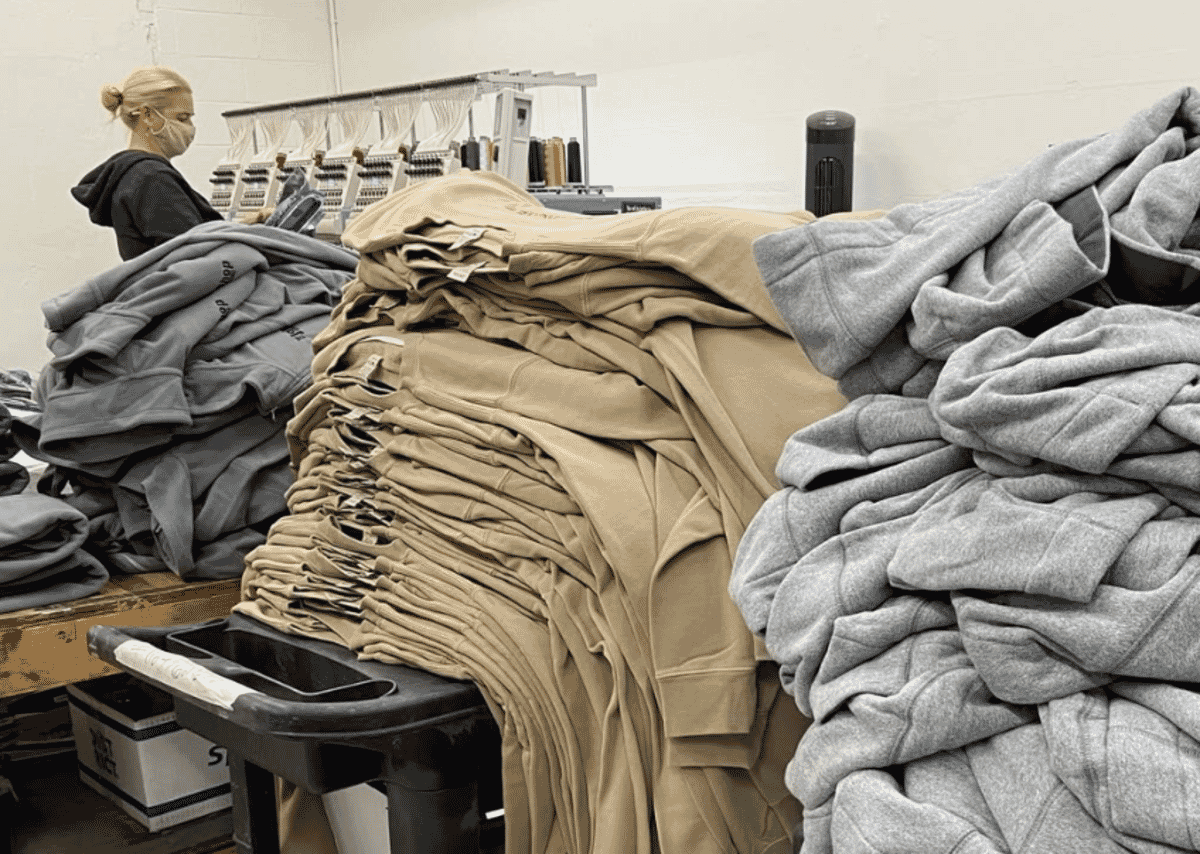
Which Leicester manufacturers publish the most detail?
Three, and between them they show what a checkable Leicester business looks like.
Colourways Textiles publishes more about itself than most. It describes itself as a third-generation family business making premium jersey in Leicester since 1972, a Living Wage employer and part of the Fast Forward labour standards programme (Colourways Textiles). It makes t-shirts, hoodies, sweatshirts and polo shirts. Its bespoke manufacturing page quotes a minimum of 120 units per style (the FAQ on the same page says 150) (Colourways bespoke manufacturing), and its white-label service on stock fabrics usually starts at around 50 units per colour (Colourways white label). One thing to check: the company number in its website footer, 12833009, belongs to Colourways Textiles Limited, which Companies House shows as dissolved on 24 July 2026 (Companies House), while Colourways Textiles Factory Limited, 13310810, is active at the same 50 Woodgate address (Companies House). Ask which entity will invoice you.
Fashion Enter operates in Leicester as well as Haringey, running the Leicester Made initiative from Phoenix House. Its London Fashion Studio quotes minimums from one, and it is SMETA audited with leading status in the Fast Forward audit (Grow London Local).
Galaxy Knitwear Ltd is the clearest primary source among the Leicester Made listings. Established in 1994 and working from 39 Spalding Street, LE5 4PH, it makes bespoke knitwear across menswear, womenswear, childrenswear and homewear. It runs knitting machines in gauges from 2.5 to 14 and states that its products are made entirely in the UK (Galaxy Knitwear). Published gauge ranges are rare, and they are the most useful thing a knitwear brand can be told before making contact.
One important correction to the directories that have not updated. Pantherella made fine English socks and hosiery on Hallaton Street from 1937. Make It British reports that the Leicester factory closed in 2024 and that the socks are no longer made in England (Make It British). The company still trades, and its own heritage page says it no longer manufactures at the Hallaton Street factory (Pantherella). It still appears on aggregator lists of active Leicester manufacturers, and for production purposes it should not. Our guide to UK sock manufacturers covers who still knits socks in Britain.
Leicester Made is a free public directory of Leicester textile and garment businesses, operated by Fashion Enter Ltd from Phoenix House, 1 Kings Street, and funded by the UK Government through the Community Renewal Fund. It lists manufacturers across garments, knitwear, fabric, labels, print and embroidery, and states explicitly that Fashion Enter does not endorse any company listed on it.
Why does the Leicester directory say it endorses nobody?
Because the alternative would be a claim nobody can honestly make. Leicester Made states plainly that Fashion Enter and the FCFTA do not endorse any company listed (Leicester Made), and that sentence is the most useful thing on the site.
A directory that endorses its listings is asserting it has audited them, continuously, and stands behind them. Almost no free directory anywhere does that, and the ones that imply it are usually taking payment for placement. Leicester Made refuses the implication, which means the listing tells you a business exists and operates in Leicester, and nothing more.
That is genuinely useful. Finding out who exists is the hard part of sourcing, and a government-funded list of real local businesses solves it. Deciding who to trust is a separate job that belongs to you, and no directory can do it from a distance.
The practical reading: use Leicester Made to build a shortlist, then verify each name yourself. Companies House for the registration, a direct question about the production address, and a visit before money moves. In Leicester in particular, treat any list, including this one, as a starting point rather than a conclusion.
Our finding: One of the most useful signals in Leicester has nothing to do with certificates. Ask to visit on a specific date at short notice, within the next week rather than next month. A factory with nothing to arrange says yes and gives you a time. The delay before an answer, not the answer itself, is what tells you whether the building you would be visiting is the building your garments would be made in.
Save the phone calls: Browse our UK factory directory for £49, or get in contact and we'll place your production with the factory in our group built for it, normally within 24 hours. Flat fee, no commissions.
What should you check before ordering in Leicester?
Five things, in this order, and none of them is optional.
The registration. Search the name on Companies House, confirm the company number, the registered address and the filing history. Colourways publishes a number on its own site, 12833009, and the register shows that company dissolved on 24 July 2026, while a separate company, Colourways Textiles Factory Limited (13310810), is active at the same address. Publishing a number is what a confident manufacturer does. Reading what it returns is your half of the job, and a company that will not give you a number is a company you cannot check.
The production address. Registered address and production address are frequently different, and only one of them has machines in it. Ask which processes happen at the address on the invoice.
The visit. This is the step that cannot be substituted. Go, at short notice, and look at the floor: how many machines, how many operators, what is currently in production, whether the place is working. An hour there answers questions no certificate does.
The invoicing entity. Check the name on the quote matches the name on the invoice and the name on the register. A mismatch means somebody sits between you and the factory. Undisclosed layers are the thing to worry about, not layers as such.
Written terms. Payment schedule, delivery date, what happens to seconds, who owns the pattern. Get it in an email before the sample. A dispute after delivery is expensive and a paragraph before production is free.
None of this is unique to Leicester. It is simply that Leicester is the city where brands are most likely to be asked afterwards whether they did it, and the only good answer is a specific one.
How does Leicester compare with other UK manufacturing cities?
| City | What it has | Typical strength | Watch out for |
|---|---|---|---|
| Leicester | Deepest cluster: garments, knit, fabric, labels, print | Jersey and knitwear at volume, fast repeats | Verification burden is higher; do the visit |
| London | Pattern cutting and sample rooms, thin on bulk | Development, tailoring, technical stretch | Cost base; addresses often unpublished |
| Birmingham | Cut and sew, streetwear and outerwear | Stated minimums, appointment-based visits | Smaller pool than Leicester |
| Manchester | Heritage brands with own factories | Outerwear and coats at the premium end | Very thin contract cut-and-sew capacity |
| Scottish Borders | Knitwear and cashmere mills | Fully fashioned knitwear, heritage cloth | Category-specific, not general apparel |
| Wales | Hosiery and knitwear heritage | Socks and hand-framed knitwear | Small number of operations |
Source: company and directory sources cited on this page and across this site, 2026. Strengths are descriptive of the local base rather than exclusive.
The comparison that matters most is Leicester against London, because those are the two places a brand actually chooses between. London develops better and Leicester produces better, and a brand that samples in London and produces in Leicester is not compromising: it is using each for what it retained.
What Leicester has that nowhere else in Britain does is density. Fabric, garment, label, print and embroidery inside a few miles is a genuine industrial cluster, and clusters are why a repeat can be delivered in weeks. Losing that would not be recoverable, which is part of why the city's problems attract the attention they do. Manchester, by contrast, has very little contract cut-and-sew capacity left, as our guide to clothing manufacturers in Manchester sets out.
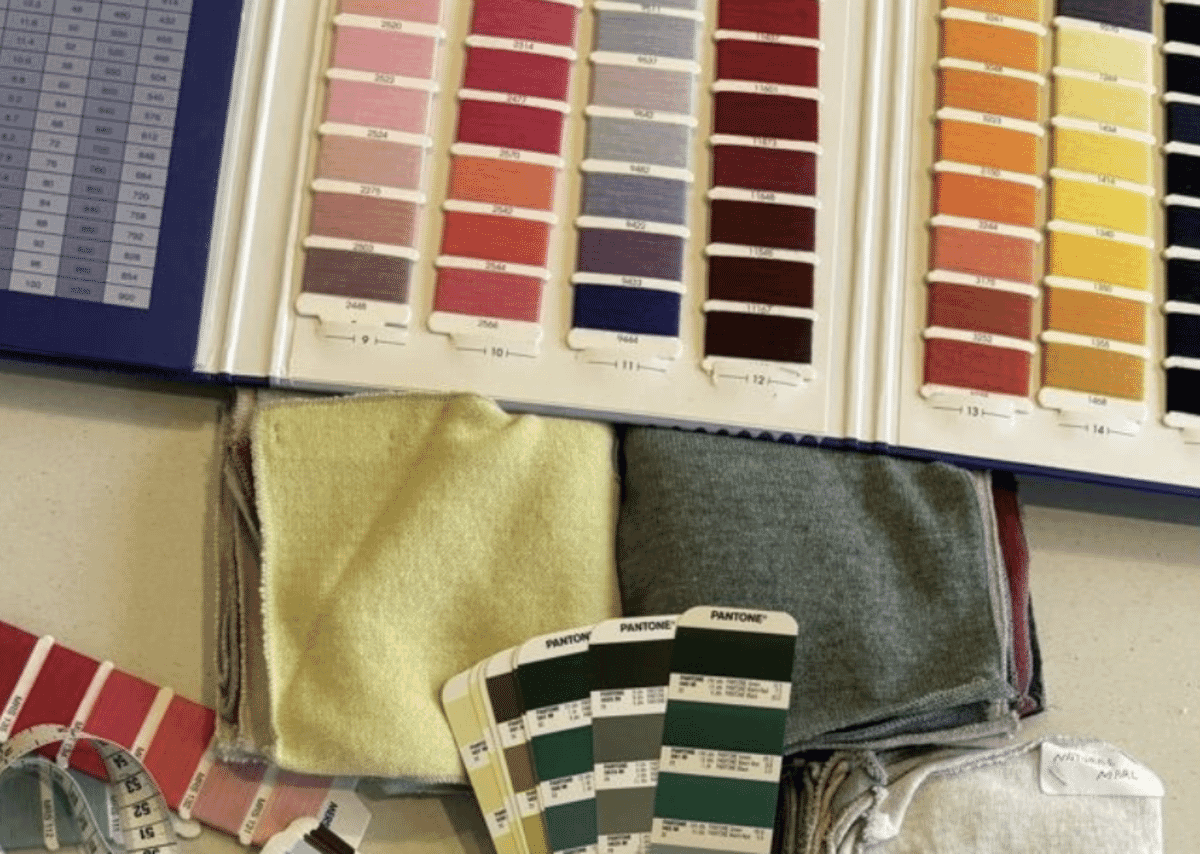
Why Leicester still has capacity when the rest of Britain does not
Because the cluster survived, and clusters are much harder to rebuild than individual factories. A garment factory on its own is a fragile business. A garment factory with a dyer, a knitter, a label printer and an embroiderer within twenty minutes is part of an ecosystem, and each member makes the others viable.
That is the practical meaning of Leicester's density. A brand can source cloth, cut and sew a garment, have labels woven, get the print or embroidery done and box the order without the work leaving the city. Every handover that would otherwise involve a courier, a lead time and a risk of damage becomes a short van journey.
The consequence shows up in repeat orders more than first orders. A first order is slow everywhere, because patterns and samples take the time they take. A repeat in Leicester can move quickly because every input is already local and the relationships already exist. For a brand that has a best seller and eight weeks of season left, that difference is the whole business.
Why does the cluster matter more than any single factory?
Because each member makes the others viable, and that is not something a single good factory can replicate.
It also explains why the city's situation matters beyond Leicester. If the cluster goes, the individual factories that remain elsewhere become markedly less viable. Each one has to solve dyeing, labelling and finishing at a distance. Britain would not lose a city's worth of capacity. It would lose the conditions that make domestic capacity work at all.
None of this is an argument for lowering your standards about who you work with. It is an argument for understanding what you are choosing between, which is rarely Leicester versus another British city. It is usually Leicester versus offshore, and those two options have entirely different verification problems rather than one having none.
Leicester's manufacturing advantage is cluster density rather than individual factory capability. Cloth, cut-and-sew, woven labels, print and embroidery all sit within a few miles. So each handover in a production run becomes a short journey rather than a courier shipment with its own lead time. This is why repeat orders can be turned round faster in Leicester than in most of Britain.
What actually changed in Leicester?
The sector came under sustained public and regulatory scrutiny. The response inside it was the growth of documentation: audits, directories, and initiatives like Leicester Made that exist to make the legitimate part of the industry findable and checkable.
We are not going to summarise the allegations or the enforcement history on this page. Doing it properly needs more room than a city listing can give, and doing it badly is worse than not doing it.
What matters for a brand deciding where to place an order is simpler and can be said here. Leicester contains excellent manufacturers and it contains businesses you should not work with, and the difference is not visible from a website. It is visible from a floor. That is why every piece of advice on this page converges on the same instruction: go and look.
There is a second change worth recording, and it cuts against the pessimistic reading. Buyers now ask. Where a garment was sewn, and under what conditions, is now a routine question for anything above the cheapest end of the market. That shift arguably does more to shape behaviour in a supply chain than enforcement alone ever did. It attaches a commercial consequence to a question that used to have none.
The brands that produce well in Leicester are, almost without exception, the ones that visit. Not once, at the start, but regularly. The relationship is the control, and it is not something a certificate can be substituted for.
The practical difference between a good and a bad manufacturing relationship in Leicester is not visible from a website, an audit certificate or a directory listing. It is visible from the production floor. Brands that produce successfully in the city are consistently those that visit before the first order and continue visiting, treating the relationship itself as the quality control mechanism.
Is Leicester still worth choosing?
For jersey and knitwear at volume in Britain, yes, and frequently there is no real alternative.
The sector nationally is large, with the UK fashion and textile industry assessed as supporting a £62 billion contribution to GDP and one in every 25 UK jobs, of which about 260,000 are in design, development and manufacturing (UKFT and Oxford Economics, via TheIndustry.fashion, 2021 data). Manufacturing is a small share of that, and a disproportionate amount of what remains is in and around Leicester. A brand that rules the city out on reputation alone is frequently ruling out the only domestic capacity for its product.
The honest position is that the extra diligence Leicester requires is real, and it is also a fixed cost rather than a recurring one. A day spent visiting three factories at the start is a day. The alternative is either producing offshore, which has its own and considerably harder verification problem, or not producing in Britain.
If you want the specification tight before you approach anyone, a factory-ready tech pack makes three Leicester quotes genuinely comparable, and how we work sets out where that fits.
Our finding: Some brands want a Leicester factory that is guaranteed clean. The honest answer is that nobody can sell that guarantee, including us. What can be offered is a documented factory, a production address, and the expectation that you go and stand in it. Any party promising more than that is either auditing continuously, which is expensive and rare, or overstating what they know.
Related Reading
- Clothing manufacturers UK: the verified list
- Best UK clothing manufacturers: how to judge them
- Clothing manufacturers in London
- UK clothing manufacturers for small businesses: low MOQ
- Made in UK clothing: what the label legally means
Frequently Asked Questions
Is Leicester still the centre of UK clothing manufacturing?
Yes, by concentration. Leicester retains the deepest cluster in Britain, covering garments, knitwear, fabric, labels, print and embroidery within a few miles. That density is why repeat orders can be turned round faster there than in most of the UK.
What is Leicester Made?
A free online directory of Leicester textile and garment businesses, run by Fashion Enter Ltd from Phoenix House, 1 Kings Street, and funded by the UK Government through the Community Renewal Fund. It lists businesses across the full production chain and states explicitly that it does not endorse any company listed.
How do I check a Leicester factory is legitimate?
Confirm the company number and registered address on Companies House, ask which processes happen at the address on the invoice, then visit at short notice. Check the entity quoting matches the entity invoicing. The visit is the step that cannot be substituted.
Is Pantherella still manufacturing in Leicester?
No. Pantherella made fine English socks and hosiery on Hallaton Street from 1937 and closed its Leicester factory in 2024. The company still trades, but no longer manufactures at Hallaton Street. It still appears on aggregator lists of active Leicester manufacturers, which is a useful reminder that a live company is not evidence of UK production.
What is the minimum order at a Leicester factory?
It varies by manufacturer and construction. Colourways Textiles quotes 120 to 150 units per style for bespoke orders and from around 50 units per colour on its white-label stock fabrics. Most Leicester manufacturers publish no figure and quote per garment, so ask against your specification rather than in the abstract. Tell us what you're making. We're a group of documented clothing factories in the United Kingdom. Tell us your product, volume and timeline, and we'll place your production with the factory in our group built for it, normally within 24 hours. You deal with the maker directly. One flat fee, no commission, no sales pitch. Brief our team, or buy the UK factory directory for £49. A factory-ready tech pack for one style is £79.
Editorial note: trade names and marks mentioned here belong to their owners. Minimums, costs and lead times are market ranges from the published sources below, not a quote from any one maker, and they vary by product, fabric and season. Duty and origin rules were checked on the publication date and may since have changed. Check your commodity code and agree terms with the maker before committing.
Sources consulted
- Leicester Made. Source of the directory description, the Fashion Enter and FCFTA operator detail, the Phoenix House address, the Community Renewal Fund funding, the non-endorsement statement and the listed business names.
- Colourways Textiles, company site, 2026. Source of the Leicester location, the company number 12833009 in its footer, the 1972 trading date, the three-generations claim, the Living Wage and Fast Forward statements, the product range and the minimums (bespoke manufacturing and white-label pages). The dissolution of 12833009 on 24 July 2026 and the active status of 13310810 are from Companies House.
- Grow London Local, ethical UK sampling and production services for fashion brands. Source of the Fashion Enter minimum of one, the SMETA and Fast Forward leading audit status and the production capacity figure.
- Make It British, the history of UK sock manufacturer Pantherella. Source of the Hallaton Street location, the 1937 date and the end of Leicester production in 2024.
- Galaxy Knitwear Ltd, company site, 2026. Source of the 39 Spalding Street, Leicester LE5 4PH address, the 1994 establishment, the bespoke knitwear range, the 2.5 to 14 gauge range and the made in UK statement.
- Leicester Made, searchable directory. The directory search interface, covering more businesses than the featured listings named on this page.
- TheIndustry.fashion, Fashion industry contributes £62bn in GDP, new report reveals, 23 November 2023. Reports the UKFT report by Oxford Economics, The Fashion and Textile Industry's Footprint in the UK: the £62 billion GDP contribution, one in every 25 UK jobs and about 260,000 jobs in design, development and manufacturing, 2021 data.
- Companies House, the UK register of companies. Cited as the verification method rather than as a source of any statistic on this page.