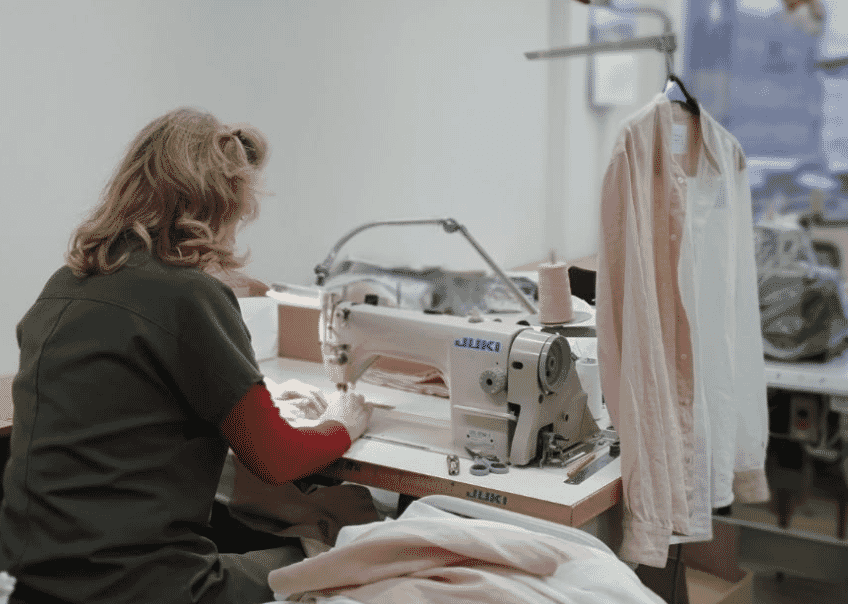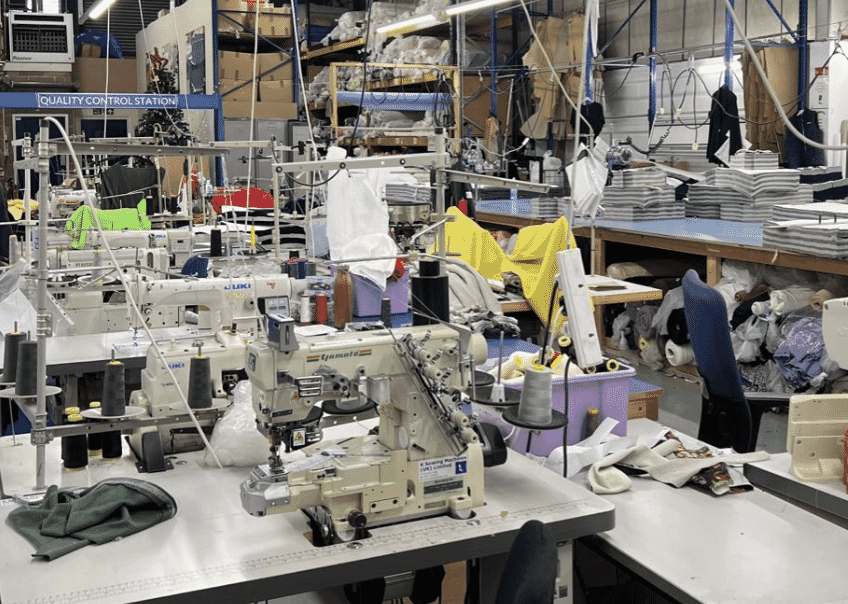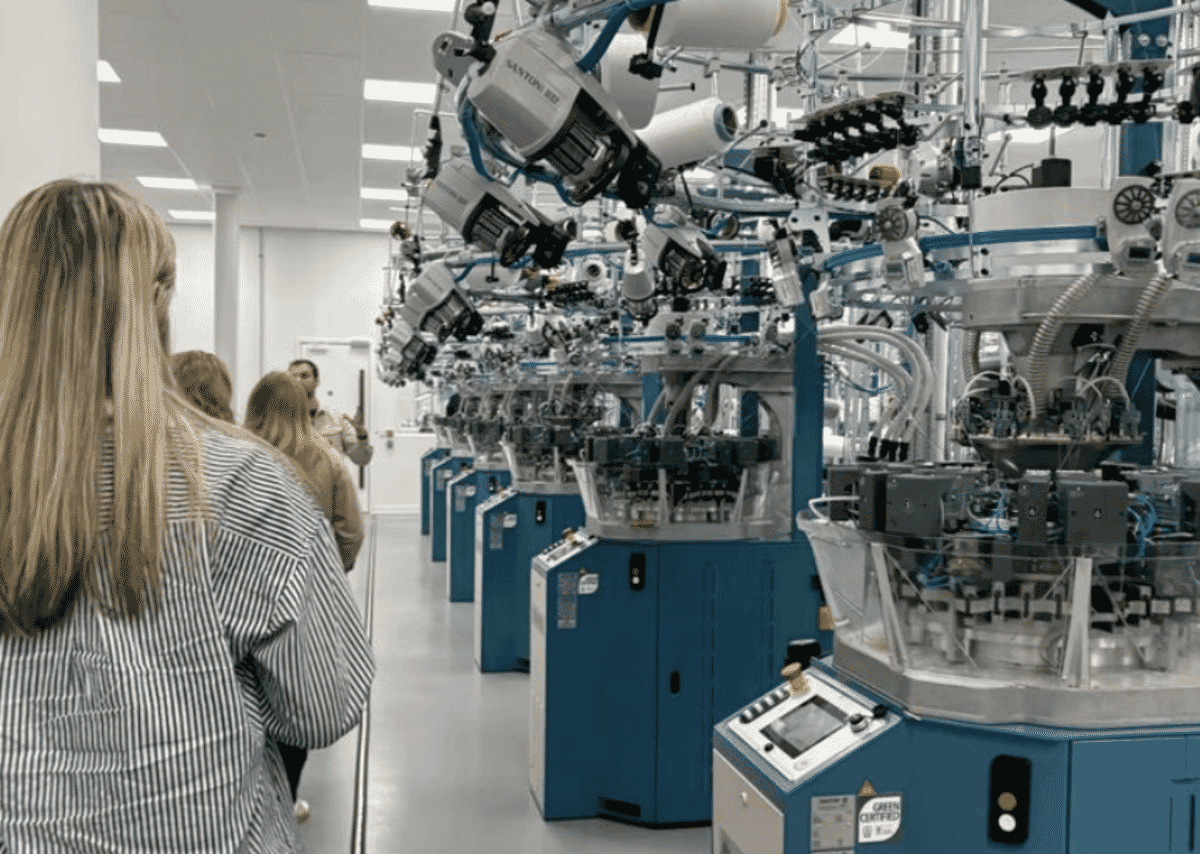
Sock manufacturers in the UK are few, old and mostly premium. The East Midlands, and Leicester and Nottingham in particular, were long the centre of British hosiery. In 2024 Pantherella, Leicester's best-known sock maker, closed its factory on Hallaton Street and stopped making its socks in England (Make It British). That is a reasonable marker of where the industry has ended up.
What survives is small, specialised and mostly at the premium end. This page names manufacturers we could check on their own websites and at Companies House, and is explicit about the one that no longer makes here. It then sets out what a brand can realistically get made in Britain.
Heads up: We're UK Clothing Manufacturers, a group of documented clothing factories in the United Kingdom. The companies named below are independent British businesses listed from their own public sources, not members of our group. Our role is separate: we place your production with a documented factory in our group built for your product.
Key Takeaways
- Corgi has knitted in Ammanford since 1892, is still run by the founding Jones family and says it employs over 60 local craftspeople (Corgi).
- J. Alex Swift has knitted socks in Hathern, Leicestershire, since 1895, knits every pair in-house and offers wholesale and bespoke socks (J. Alex Swift).
- John Smedley has made knitwear at Lea Mills since 1784 and in 2024 opened its Derbyshire factory to third-party manufacturing (John Smedley; Knitting Industry Creative).
- Pantherella closed its Leicester factory in 2024 after 87 years on Hallaton Street (Make It British). The company still trades, which is the point.
- Hosiery is a knitting industry, not a cut-and-sew one. Machine gauge and yarn, not patterns and cutting tables, set what is possible.
- Minimums are set by machine setup, so they behave differently from garment minimums and are rarely published.
Have a product in mind? Tell us the product, quantity and timeline and our team replies within 24 hours. Send a brief →
Try it free: Work out your true cost per garment in 60 seconds with our garment cost calculator. No email required.
Which sock manufacturers still operate in the UK?
Corgi Hosiery Ltd (Ammanford, Carmarthenshire). Rhys Jones began making thigh-high woollen socks for local coal miners in 1892, and the business is still run by the Jones family. Corgi says it makes hand-framed knitted garments, accessories and hand-finished socks in-house, in wool, cotton and cashmere (Corgi, our story), and that it employs over 60 local craftspeople (Corgi, inside our factory). Corgi Hosiery Limited is company 03441080 at Companies House, status active, registered in Ammanford.
It holds a Royal Warrant, which it says was awarded in 1989 (Corgi, Royal Warrant). Corgi sells mainly under its own name, online and through its factory shop in Ammanford (Corgi, FAQs). It does not publish terms for making socks under other brands' labels, so ask before assuming it takes that kind of work.
John Smedley (Lea Mills, Derbyshire). John Smedley says it has made knitwear at Lea Mills since 1784, calls the mill the world's oldest continuously operating factory still manufacturing today, and says every John Smedley garment is still made in England. It was granted a Royal Warrant in 2013, renewed in 2024 (John Smedley, our history). Make It British reports that its men's UK-made socks are produced at the Lea Mills factory (Make It British). John Smedley Limited is company 00040000 at Companies House, status active, registered at Lea Mills.
Smedley is the name here with a reported opening for contract production. In May 2024 Knitting Industry Creative reported that it was opening its Derbyshire factory to third-party manufacturing, with its production schedule open to brands from April 2024 for the first time in more than 40 years (Knitting Industry Creative). That report is about knitwear, from fine gauge to chunky, so ask directly whether socks are included and what terms apply now.
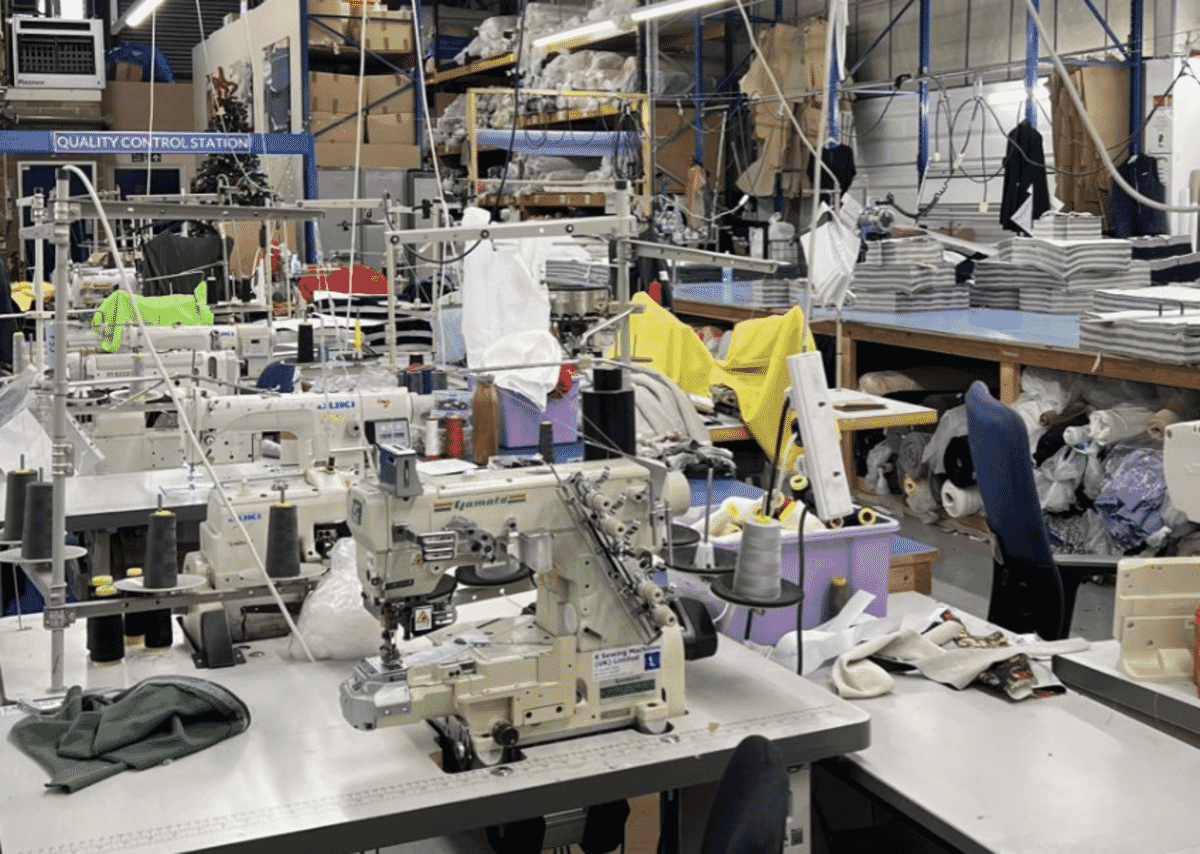
Which Leicestershire sock maker still knits in-house?
One family firm in Leicestershire still knits socks in its own factory and publishes a wholesale and bespoke offer. For jumpers and cardigans rather than socks, see our guide to knitwear manufacturers in the UK.
J. Alex Swift (Hathern, Leicestershire). John Alexander Swift founded the business in 1895 in the village of Hathern, where it remains, and the Swift family still runs it. It says it knits every pair in-house from natural fibres such as alpaca, wool, cashmere and mohair, on traditional double-cylinder machines (some knitting since the 1960s) alongside newer Italian and Japanese machinery, and that many of its socks are hand-linked (J. Alex Swift, our history). Its wholesale page says the full range goes well beyond its online shop and that it is happy to talk about bespoke socks (J. Alex Swift, wholesale). J.Alex Swift Limited is company 00582072 at Companies House, status active, registered in Hathern.
Citation capsule: Corgi Hosiery has knitted in Ammanford, Carmarthenshire since 1892 and says it employs over 60 local craftspeople making hand-framed knitwear and hand-finished socks. J. Alex Swift has knitted socks in Hathern, Leicestershire since 1895 and offers wholesale and bespoke socks. John Smedley has made knitwear at Lea Mills in Derbyshire since 1784 and opened its factory to third-party manufacturing in 2024.
What happened to Pantherella?
It stopped making socks in England. Pantherella started as Midland Hosiery Mills on Hallaton Street in Leicester in 1937 and made fine English socks there. Make It British reports that the Leicester factory closed in 2024 and that the socks are no longer made in England (Make It British). Pantherella's own heritage page says it no longer bases its manufacturing at the Hallaton Street factory (Pantherella). Pantherella Limited, company 04136274, is still active at Companies House.
It matters beyond the individual business for two reasons. The first is practical, and it is a sharper lesson than the one brands usually take from a factory going quiet. Pantherella still appears on current lists of UK sock manufacturers. Its website is live, its brand is intact and its English heritage is still the story it tells. None of that tells you where the socks are knitted. A live company is not evidence of UK production, and the question that settles it is where the machines are, not whether the business exists.
The second is structural. Circular sock knitting machines are set up for particular gauges and yarns, and the skill to run them well is built up over years. In our view, when a hosiery factory closes, that capacity rarely moves to another British maker, so it is not quickly replaced when demand improves.
Which is why the remaining operations are worth understanding properly rather than treating as interchangeable options. There are not many of them.
Our view: A common mistake in sourcing British socks is approaching a brand rather than a manufacturer. Several British sock names sell mainly their own product, and an open enquiry may get no useful reply. The question to ask first is not whether they can make your sock, but whether they make socks for anyone other than themselves.
Skip weeks of cold outreach: Browse our UK factory directory for £49, or get in contact and we'll place your production with the factory in our group built for it, normally within 24 hours. Flat fee, no commissions.
How do UK sock manufacturers compare?
| Manufacturer | Location | Since | Makes | Companies House | Notable |
|---|---|---|---|---|---|
| Corgi Hosiery | Ammanford, Wales | 1892 | Hand-finished socks, hand-framed knitwear | 03441080, active | Over 60 local craftspeople; Royal Warrant 1989; sells mainly under its own name |
| J. Alex Swift | Hathern, Leicestershire | 1895 | Natural-fibre socks: alpaca, wool, cashmere, mohair | 00582072, active | Knits in-house; wholesale range and bespoke socks on enquiry |
| John Smedley | Lea Mills, Derbyshire | 1784 | Fine knitwear; men's socks | 00040000, active | Royal Warrant 2013, renewed 2024; factory opened to third-party brands in 2024 |
| Pantherella | Leicester (factory closed) | 1937 | Fine socks | 04136274, active | Leicester factory closed 2024; socks no longer made in England |
Source: company websites, Make It British, Knitting Industry Creative and Companies House, checked 23 October 2026. None of these manufacturers publishes a minimum. Pantherella is listed because it still appears on some lists as a British sock manufacturer.
Two things stand out. The first is the dates. 1784, 1892 and 1895 are not marketing flourishes. In our view they matter because the knowledge needed to run fine knitting machines well is passed on person to person rather than bought.
The second is that none of them publishes a minimum. That is common in hosiery, and it reflects how the economics work rather than reticence. A sock minimum depends on machine gauge, yarn, whether the design requires a change of setup, and how many sizes you need. Ask against your specification.
Why are sock minimums different from garment minimums?
Because socks are knitted rather than cut and sewn, and knitting machines carry a setup burden that cutting tables do not.
A circular knitting machine is set to a gauge, threaded with specific yarns, and programmed for a specific design. Changing any of those is a setup operation that takes time and produces waste before the first good sock appears. That cost is recovered across the run, much like a garment factory's marking and cutting setup, but it is less flexible.
The consequences are worth planning around.
Colour and pattern changes add setup. Each new colourway or pattern means rethreading or reprogramming the machine, so a range with many colourways costs more to set up than one with few.
Yarn choice constrains the machine, not just the price. A fine gauge machine cannot run a heavy yarn and a coarse gauge machine cannot produce a fine sock. Asking which gauges a manufacturer runs is more useful than asking what it can make.
Sizes add setup too. Socks are usually offered in size ranges rather than individual sizes, and each size can need its own machine setting or a different machine. A three-size range across two colourways can mean several separate setups, not two.
Get the minimum stated against a full specification including gauge, yarn, colourway count and size range, in writing. A sock quote given without those is an estimate of uncertainty rather than of cost.
Citation capsule: Sock minimums are driven by knitting machine setup rather than by cutting and sewing. A circular knitting machine is set to a specific gauge, threaded with specific yarns and programmed for a specific design. Changing any of those requires a setup operation, with waste before the first saleable sock. Each extra colourway, pattern or size can add a setup.
What can you realistically get made in Britain?
Premium socks in natural fibres at modest volume, and very little else.
In our view the UK is not a competitive source for basic cotton socks at volume. That market is served at prices British manufacturing cannot match, and no amount of provenance changes the arithmetic on a three-pack.
What Britain does well is the opposite end: fine gauge, natural fibres, hand-finished toes, and constructions that reward skill. Cashmere, merino, alpaca, Sea Island cotton. Socks where the customer is buying the make rather than the quantity, and where a visible difference justifies a visible price.
There is a middle path that suits some brands: one British-made capsule alongside a main range made elsewhere. That lets a brand carry one genuinely British product while importing the volume lines, as long as the product pages say which is which. Ask each manufacturer whether it will take a small capsule order; none of those on this page publishes terms for it.
The realistic brief is therefore narrow and specific: a small range, a good yarn, a finish that shows, and a price point that supports it. Brands that arrive with that brief have options here. Brands that arrive wanting a cheaper version of what they currently import usually do not, and finding out early saves everyone the correspondence.
A factory-ready tech pack makes a hosiery brief legible to a mill. How we work explains where that fits before you approach anyone.
What British sock making still has that volume production does not
Three things, and each of them shows up in the finished product rather than only in the story.
The toe. A sock is closed at the toe, and that seam is where comfort is won or lost. Hand-linking joins the two sides stitch by stitch; J. Alex Swift describes it as giving a smoother, more comfortable seam than machine linking alone (J. Alex Swift). It is slow, skilled work, and one of the clearest differences at the premium end.
Fine gauge capability. Gauge describes how many needles a machine carries across a given width, and finer gauges produce a denser, smoother fabric. Fine gauge machines run slower, waste more on setup and demand better yarn, so they suit markets that will pay for the result. In our view that is why fine work is where British hosiery has held on.
Yarn access and the knowledge of what to do with it. Cashmere, merino, alpaca and Sea Island cotton all behave differently on a knitting machine, and getting a good sock from each is not the same problem. A mill that has run these yarns for decades knows which tensions and finishing routines work, and that knowledge does not appear in a specification. It appears in the first sample.
Is a British-made sock worth the price?
Only if your customer can detect the difference, and in this category the difference is unusually detectable.
What none of this does is make British socks cheap, and no brand should approach the category expecting otherwise. The right question is whether your customer can tell the difference and will pay for it. For a three-pack of basics the answer is no and the category is not for you. For a single pair at a price that reflects the make, the answer is often yes, and the visible evidence is right there at the toe.
There is one further advantage that matters commercially rather than physically. Socks are small and light, so carriage is a smaller share of their cost than it is for bulky garments, and making them close to the customer costs little extra in freight.
Citation capsule: British sock manufacturing retains three advantages that appear in the product rather than only in the provenance. Hand-linked toes give a smoother seam than machine linking. Fine gauge knitting suits buyers who will pay for density and smoothness. And decades of accumulated knowledge covers how cashmere, merino, alpaca and Sea Island cotton behave on a knitting machine.
How do you verify a UK sock manufacturer?
Open the website, then check Companies House, then ask about gauge.
The website check is not a formality in this category, because a recently closed factory still appears in directories. The register is free and public (Companies House). Confirm the company number, the registered address and, importantly here, the filing history, which shows whether a business is filing as a going concern.
Then ask the technical question: which gauges do you run, and which yarns are you set up for? A genuine hosiery manufacturer answers immediately and specifically, because that is the shape of its business. A company arranging production elsewhere will usually describe capability in general terms and avoid the numbers.
Ask also where the yarn comes from. In hosiery the yarn is a big part of the cost. A manufacturer with long-standing spinner relationships may offer yarns a buyer of open-market yarn cannot; J. Alex Swift, for example, says its alpaca is specially spun for it in South America (J. Alex Swift).
Then ask where the toe is closed and how. Hand-linking, machine linking and seamless toe closing produce visibly and palpably different results, and it is often the detail a customer notices first. A manufacturer will tell you exactly which it does.
Ask one more question that separates a manufacturer from a reseller in this category specifically: what do they do with seconds. Knitting produces faults, every hosiery operation deals with them, and a manufacturer will describe its grading and disposal routine without hesitating. A company that has never had to decide what happens to a flawed sock has never made one.
Finally, ask for a sample in your yarn. Hosiery samples are comparatively cheap because they use little material, which makes this one of the easier categories to test properly before committing.
Our view: Asking a hosiery manufacturer what gauges it runs is one of the quickest filters we know. It takes one line, and it is hard to answer plausibly without owning knitting machines. The answer tells you whether your product is possible there. Most brands ask instead whether the manufacturer can make their sock, which invites a yes from everyone.
Related Reading
- Clothing manufacturers UK: the verified list
- Knitwear manufacturing in the UK
- Clothing manufacturers in Wales
- Clothing manufacturers in Leicester
- Best UK clothing manufacturers
Frequently Asked Questions
Are socks still made in the UK?
Yes, but by few manufacturers and mostly at the premium end. Corgi has knitted in Ammanford since 1892, J. Alex Swift in Hathern, Leicestershire since 1895, and John Smedley makes knitwear and men's socks at Lea Mills in Derbyshire. Pantherella closed its Leicester factory in 2024.
What is the minimum order for UK-made socks?
None of the UK sock manufacturers on this page publishes a figure. The minimum depends on machine gauge, yarn, colourway count and size range, because each change can mean a separate machine setup. Ask against a full specification rather than in the abstract.
Can I get cheap basic socks made in Britain?
Not competitively, in our view. UK hosiery survives mainly in fine gauge, natural fibre and hand-finished work where the customer is buying the make. Basic cotton socks at volume are usually sourced elsewhere, at prices British manufacturing cannot match.
Does Pantherella still make socks in the UK?
No. It made socks on Hallaton Street in Leicester from 1937 and closed its Leicester factory in 2024. The company still trades, so a live website tells you nothing here. Ask where the knitting machines are.
What is the difference between hand-finished and machine-finished socks?
It is mainly the toe closure. Hand-linking joins the toe stitch by stitch and gives a smoother seam than machine linking alone; it is slow, skilled work, which is why it appears at the premium end. Corgi says it hand-finishes its socks in Wales, and J. Alex Swift says many of its socks are hand-linked.
Editorial note: all company names, certification marks and trademarks referenced here are the property of their respective owners. Company facts come from each company's own website, Make It British, Knitting Industry Creative and Companies House, checked on 23 October 2026. None of the companies named is part of our group, and we do not place orders with them or send brands to them. Confirm terms directly with any manufacturer before committing.
Sources
- Corgi, our story and heritage. Source of the 1892 founding by Rhys Jones, the family ownership and the in-house hand-framed knitwear and hand-finished socks.
- Corgi, inside our Welsh factory. Source of the over-60 local craftspeople figure.
- Corgi, Royal Warrant. Source of the Royal Warrant awarded in 1989.
- Corgi, FAQs. Source of the factory shop in Ammanford.
- J. Alex Swift, our history. Source of the 1895 founding in Hathern, the family ownership, in-house knitting, the natural fibres, the double-cylinder and newer machinery, hand-linking and the specially spun alpaca.
- J. Alex Swift, wholesale. Source of the wholesale range and bespoke socks.
- John Smedley, our history. Source of the 1784 founding at Lea Mills, the oldest continuously operating factory claim, garments made in England and the Royal Warrant granted in 2013 and renewed in 2024.
- Knitting Industry Creative, John Smedley opens Derbyshire factory for third-party manufacturing (May 2024). Source of the factory opening to third-party brands from April 2024, for the first time in more than 40 years.
- Make It British, made in the UK sock brands. Source of John Smedley's men's UK-made socks being produced at Lea Mills.
- Make It British, the history of UK sock manufacturer Pantherella. Source of the Hallaton Street location, the 1937 start as Midland Hosiery Mills and the closure of the Leicester factory in 2024.
- Pantherella, Leicester heritage. Company source confirming that it no longer bases its manufacturing at the Hallaton Street factory.
- Companies House: Corgi Hosiery Limited, 03441080, J.Alex Swift Limited, 00582072, John Smedley Limited, 00040000 and Pantherella Limited, 04136274, all active on 23 October 2026.