Clothing manufacturers in Wales are fewer than in England or Scotland, and the businesses covered here are unusual in a specific way. Two of the three describe themselves as family businesses, and the third is now owned through an Employee Owned Trust by the people who work in it.
This is a short list because the verified list is short. Three businesses are covered in detail, each with a public trace going back decades or longer. Padding it out to ten with companies that cannot be checked would make the page longer and less useful, so it is not done here.
Heads up: We're UK Clothing Manufacturers, a group of documented clothing factories in the United Kingdom. The companies named below are independent British businesses listed from their own public sources, not members of our group. Our role is separate: we place your production with a documented factory in our group built for your product.
Key Takeaways
- Corgi has knitted in Ammanford since 1892, is still run by the founding Jones family, and says it employs over 60 local craftspeople (Corgi).
- Melin Tregwynt has been employee owned since 2022. The Griffiths family bought the Pembrokeshire mill in 1912, and it says it employs over 40 local people (Melin Tregwynt).
- Corgi holds a Royal Warrant, which the company says was awarded in 1989 (Corgi).
- First Corporate Clothing makes uniforms in its own Port Talbot factory; a 2017 trade-press profile counted 20 machinists (First Corporate Clothing, Printwear & Promotion).
- Wales is a specialist base: the makers covered here work in hosiery, knitwear, woven cloth and corporatewear, not general fashion cut and sew.
Have a product in mind? Tell us the product, quantity and timeline and our team replies within 24 hours. Send a brief →
Try it free: Work out your true cost per garment in 60 seconds with our garment cost calculator. No email required.
Which clothing manufacturers operate in Wales?
Corgi Hosiery Ltd (Ammanford, Carmarthenshire). Rhys Jones began making thigh-high woollen socks for local coal miners in 1892, and the business is still run by the Jones family. Corgi says it makes hand-framed knitted garments, accessories and hand-finished socks in-house, in wool, cotton and cashmere (Corgi, our story), and that it employs over 60 local craftspeople (Corgi, inside our factory). Corgi Hosiery Limited is company 03441080 at Companies House, status active, registered in Ammanford.
Corgi sells mainly under its own name, online and through its factory shop in Ammanford (Corgi, FAQs). It holds a Royal Warrant of Appointment, which it says was awarded in 1989, and it lists royal visits to the factory (Corgi, Royal Warrant). It does not publish terms for making product under other brands' labels, so ask before assuming it takes that kind of work. For other British sock makers, see our guide to sock manufacturers in the UK.
Hand-framing is the detail worth understanding. It is a slower, more manual way of knitting than fully automated machine knitting, and that shows in the price of a hand-framed garment.
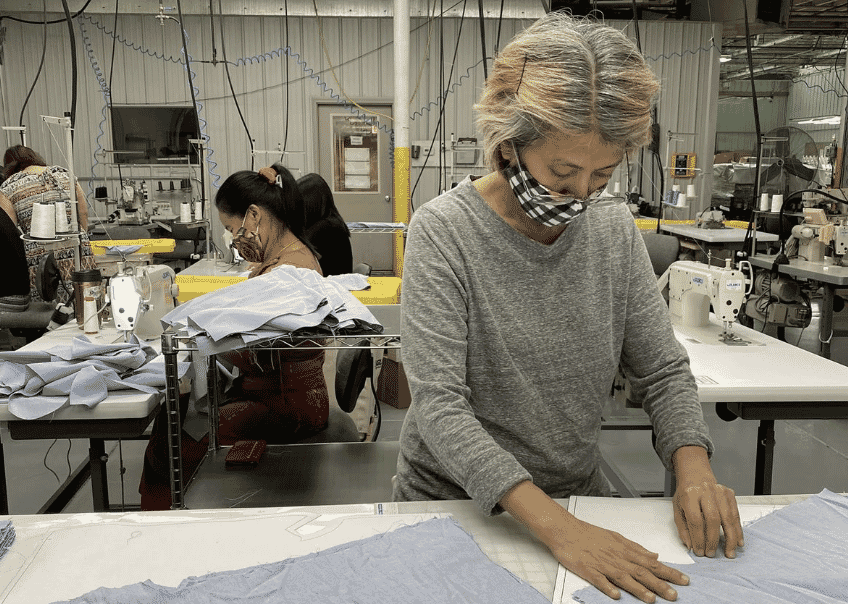
First Corporate Clothing (Port Talbot). A family-run corporate clothing supplier that makes its own ranges of women's and men's uniforms in its own factory in Port Talbot, on a 33,000 sq ft site that houses design, manufacture and despatch (First Corporate Clothing, our story; Made in Great Britain). A 2017 Printwear & Promotion profile reported that it was formed in 1998 and employed 20 machinists making blouses, shirts, jackets and bespoke corporatewear (Printwear & Promotion); a current headcount is not published. First Corporate Clothing Limited is company 03667081 at Companies House, status active. Its offer is aimed at organisations buying uniform, so it is relevant to a brand only if the product is corporatewear. Our guide to workwear manufacturers in the UK covers it alongside other uniform and protective clothing makers.
Which business on this list weaves cloth?
One: Melin Tregwynt. Wales.com describes it as one of a handful of businesses that survive from a time when almost every Welsh valley had its own woollen mill.
Melin Tregwynt (Pembrokeshire). A woollen mill in a wooded valley near Fishguard, less than a mile from the Pembrokeshire coast (Wales.com). The mill dates from the eighteenth century and was originally a corn mill, later a fulling mill. Weaving was first recorded there in the 1841 census, and Henry Griffiths bought the mill in 1912 (Melin Tregwynt, about us).
It weaves double cloth, known as Welsh tapestry, by weaving two layers together to produce a durable fabric with bold areas of pattern, a technique that has been around since the eighteenth century (Wales.com). In 2022 the family set up an Employee Owned Trust, which the company says was done to preserve its legacy, protect skills and jobs and safeguard its heritage. It says it employs over 40 local people (Melin Tregwynt, about us). Its wholesale page lists shops, interior designers, specifiers, architects and hotels as trade customers for blankets, throws, cushions and upholstery (Melin Tregwynt, wholesale). Melin Tregwynt Limited is company 08333693 at Companies House, status active.
Citation capsule: Corgi Hosiery has knitted in Ammanford, Carmarthenshire since 1892, is still run by the founding Jones family, says it employs over 60 local craftspeople and holds a Royal Warrant it says was awarded in 1989. Melin Tregwynt, a woollen mill near Fishguard in Pembrokeshire bought by the Griffiths family in 1912, weaves the double cloth known as Welsh tapestry and has been owned through an Employee Owned Trust since 2022, with over 40 staff.
What does family and employee ownership mean for a brand?
In our view, it mostly affects how these businesses take on work, rather than what they can make.
Melin Tregwynt's move to an Employee Owned Trust in 2022 is a clear example. The stated reasons were preserving the legacy, protecting skills and jobs, and safeguarding heritage. That is a succession decision rather than a sale, and it keeps control with the people who already run the mill.
For a brand sourcing here, the ownership structure can have a practical consequence. A business that plans to continue, rather than to be sold, has good reason to be careful about taking on work it cannot do well.
Our view: A family or employee-owned manufacturer that turns down a job is not necessarily being unhelpful. A business that intends to be around in thirty years has little reason to accept work it would do badly, because the reputational cost lands on the same people. A quick no is more useful than a slow maybe.
Skip weeks of cold outreach: Browse our UK factory directory for £49, or get in contact and we'll place your production with the factory in our group built for it, normally within 24 hours. Flat fee, no commissions.
How do Welsh manufacturers compare?
| Manufacturer | Location | Since | Makes | Scale | Notable |
|---|---|---|---|---|---|
| Corgi Hosiery | Ammanford, Carmarthenshire | 1892 | Hand-framed knitwear, hand-finished socks, accessories, mainly under its own name | 60+ craftspeople | Royal Warrant 1989, family run, company 03441080 active |
| Melin Tregwynt | Pembrokeshire, near Fishguard | Mill from the 18th century; Griffiths family from 1912 | Double cloth, blankets, throws, cushions, upholstery fabric; clothing and bags in its own fabrics | 40+ employees | Employee Owned Trust since 2022, company 08333693 active |
| First Corporate Clothing | Port Talbot | 1998 (2017 profile) | Own-range and bespoke corporatewear: blouses, shirts, jackets | 20 machinists (2017) | Own factory on a 33,000 sq ft site, company 03667081 active |
Source: company websites, Wales.com, Printwear & Promotion (2017) and Companies House, checked 22 October 2026. Minimums are not published by any of the three.
None of the three publishes a minimum order quantity. Ask against your specification rather than in the abstract, and expect the answer to depend on the yarn or cloth as well as on the garment count.
The three do different things. One makes knitwear and hosiery, mainly under its own name; one weaves cloth; one makes corporatewear. A brand uses whichever suits its product, or none of them.
What can you actually make in Wales?
Three things, based on the businesses covered here.
Hand-framed knitwear and socks. Corgi's specialism. Suitable for a brand where the construction is part of the product and the price point supports it, if Corgi agrees to make for another label. Corgi also knits beanies; see our guide to hat manufacturers in the UK.
Woven wool cloth, including double cloth. Melin Tregwynt's Welsh tapestry is a distinctive, recognisable fabric. The mill sells fabrics, blankets, throws and cushions, plus clothing and bags made in its own fabrics. Ask directly whether it will supply cloth for another brand's garments, which would then be made elsewhere. For bags made in Britain, see our guide to bag manufacturers in the UK.
Corporatewear and uniform. First Corporate Clothing in Port Talbot, for organisations that buy uniform.
What you will not readily find on this list is general cut-and-sew capacity for a fashion range. We know of no Welsh equivalent of the Leicester cluster, so a brand wanting 300 jersey hoodies would usually look to the East Midlands; our guide to clothing manufacturers in Leicester covers that cluster. In our view, Wales works best as a source for a specific product or cloth rather than a whole range.
Citation capsule: The Welsh manufacturers covered here work in three garment-related categories: hand-framed knitwear and hosiery, woven wool cloth including the double cloth known as Welsh tapestry, and corporatewear. We know of no Welsh equivalent of the Leicester cut-and-sew cluster, so general fashion production is usually better sourced in the East Midlands, with Welsh makers used for specific products or cloth.
Does Welsh manufacturing carry a marketing advantage?
It can, and it is more specific than general British provenance.
Wales has a distinct national identity and customers who respond to it. A Royal Warrant, like Corgi's, is a credential a buyer can check rather than take on trust.
Melin Tregwynt's patterns work in a different way. Welsh tapestry is visually recognisable, and a recognisable cloth does marketing work a description cannot. Wales.com reports that the mill's patterns have fans as far afield as the United States and Japan.
There is a caveat. Welsh customers notice Welsh identity claims, and a brand that implies Welsh manufacture while sewing elsewhere risks being called out. If the cloth is Welsh and the garment is made in Leicester, say exactly that. It is a good story and it has the advantage of being true.
The legal position is the same as everywhere in the UK: origin labelling is voluntary, and once you make a claim it has to hold. Our guide to what the Made in UK label legally means covers the substantial transformation test and the enforcement position in detail.
What a small manufacturing base means for lead times
It means capacity is the constraint rather than capability, and that changes how you plan rather than whether you proceed.
A mill with a handful of looms can weave anything those looms can weave, but it can only weave one thing at a time. A knitting operation with a fixed number of hand frames, and the skilled people to work them, has a weekly output. It does not flex upward for a good customer or an urgent order. Adding capacity means finding and training someone, which takes months rather than weeks: First Corporate Clothing's managing director told Printwear & Promotion in 2017 that it can take six months to train a machinist.
The consequence is that lead times in a small specialist base behave differently from lead times at a large contractor. At a large factory a delay often means your job slipped in a queue, and pressure can sometimes move it. At a small one the queue is most of the business, and there is little room for your job to move. Pushing harder rarely helps and can damage the relationship.
How should you plan around fixed capacity?
By booking a season ahead and ordering predictably, because neither pressure nor price will move a queue that is the whole business.
What works is booking early and being predictable. A brand that says in September what it wants in March is far more likely to get it in March. A brand that asks in January for March is asking to displace someone who booked earlier, and the answer will often be no.
There is a second-order effect. When capacity is fixed, a manufacturer has good reason to value customers who order regularly at modest volume, because a predictable 200 units every season is easier to plan around than an unpredictable 800.
This also explains something brands often misread as coldness. A small specialist asked for an urgent quote may take several days to answer. In a small business the person who prices work often has other jobs too, so a slow reply says more about staffing than about interest in the job.
Citation capsule: In a small specialist manufacturing base, capacity rather than capability is the binding constraint. A mill with a fixed number of looms or hand frames has a weekly output that does not flex for an urgent order, because adding capacity requires training a person over months. In our view, booking a season ahead and ordering predictably count for more with these manufacturers than order size alone.
How do you approach a Welsh manufacturer?
Directly, with a specific brief, and with patience about timing.
These are small businesses by headcount: Corgi says it employs over 60 craftspeople and Melin Tregwynt over 40. Enquiries may be handled by people who also have other jobs, so allow a week for a reply and follow up politely if you hear nothing.
Lead with the product and the yarn or cloth, not the brand story. For knitwear, specify the yarn and the gauge if you know them. For cloth, specify the weight and the end use. Those details let a specialist tell you quickly whether the job suits their machines, which is the question that matters first.
Verify as you would anywhere: search the company on Companies House, confirm the registration number and registered address, and check the entity quoting matches the entity invoicing.
Ask about visiting. Corgi runs a factory shop in Ammanford, Melin Tregwynt has a shop and café at the mill, and First Corporate Clothing says it welcomes clients to its factory. Seeing the process first hand does more for a working relationship with a small business than a long email thread.
And expect a conversation about next season. Hand-framing and weaving run at fixed speeds, and a small workforce has finite capacity. A factory-ready tech pack makes the brief legible to a specialist. How we work explains where that sits in the sequence.
Our view: A brand that asks a small heritage manufacturer what it can do usually gets a less useful answer than one that asks whether it can make a specific thing. A business with a small team cannot usefully answer an open question. Ask about one product, one cloth and one quantity, and the reply is far more likely to be specific.
Related Reading
- Clothing manufacturers UK: the verified list
- Clothing manufacturers in Scotland
- Knitwear manufacturing in the UK
- Clothing manufacturers in Leicester
- Best UK clothing manufacturers
Frequently Asked Questions
Are there clothing manufacturers in Wales?
Yes, though the base is small and specialised. Corgi Hosiery knits in Ammanford, Melin Tregwynt weaves cloth in Pembrokeshire, and First Corporate Clothing makes corporatewear in Port Talbot. We know of no general fashion cut-and-sew cluster in Wales comparable to Leicester.
What is Corgi Hosiery?
A Welsh sock and knitwear maker founded in Ammanford in 1892 by Rhys Jones and still run by the same family. It says it employs over 60 local craftspeople and holds a Royal Warrant awarded in 1989, and it sells mainly under its own Corgi name.
What is Welsh tapestry cloth?
A double cloth woven by joining two layers together to create a durable fabric with bold areas of pattern, a technique that has been around since the eighteenth century. Melin Tregwynt in Pembrokeshire weaves it, and Wales.com reports fans of its patterns as far afield as the United States and Japan.
Can I get a fashion range cut and sewn in Wales?
Not easily. We know of no Welsh equivalent of the Leicester cluster, and the manufacturers covered here are specialists in knitwear, woven cloth and corporatewear. A general range is usually produced elsewhere, with a Welsh maker used, if at all, for a specific product or cloth.
Can I say Made in Wales if the fabric comes from elsewhere?
Origin follows the last substantial transformation, normally evidenced by a change in commodity code, so a garment cut and sewn in Wales from imported cloth is made in Wales. Origin labelling is voluntary in the UK, but once a claim is made it has to hold.
Editorial note: all company names, certification marks and trademarks referenced here are the property of their respective owners. Company facts come from each company's own website, Wales.com, a 2017 Printwear & Promotion profile and Companies House, checked on 22 October 2026. None of the companies named is part of our group, and we do not place orders with them or send brands to them. Confirm terms directly with any manufacturer before committing.
Sources
- Corgi, our story and heritage. Source of the 1892 founding by Rhys Jones, the family ownership and the in-house hand-framed knitwear and hand-finished socks.
- Corgi, inside our Welsh factory. Source of the over-60 local craftspeople figure.
- Corgi, Royal Warrant. Source of the Royal Warrant awarded in 1989 and the royal visits.
- Corgi, FAQs. Source of the factory shop in Ammanford.
- Melin Tregwynt, about us. Source of the eighteenth-century mill, its corn and fulling mill history, weaving recorded in the 1841 census, the 1912 purchase by Henry Griffiths, the 2022 Employee Owned Trust and its stated reasons, and the over-40 local staff figure.
- Melin Tregwynt, wholesale. Source of the trade customers and wholesale product range.
- Wales.com, Melin Tregwynt. Source of the location near Fishguard, the double cloth technique, the handful of surviving woollen mills and the following in the United States and Japan.
- First Corporate Clothing, our story and Made in Great Britain. Source of the family-run business, its own Port Talbot factory, the 33,000 sq ft site and client factory visits.
- Printwear & Promotion, proudly designed and made in Wales (September 2017). Source of the 1998 formation, the 20 machinists figure, the product range and the six months it can take to train a machinist.
- Companies House: Corgi Hosiery Limited, 03441080, Melin Tregwynt Limited, 08333693 and First Corporate Clothing Limited, 03667081, all active on 22 October 2026.