UK clothing manufacturers for small businesses compete on one thing above all others, and it is the low minimum order quantity. That is what domestic factories genuinely sell. It is also the phrase most abused in the sector: "low MOQ" appears on hundreds of manufacturer pages and means a different number on nearly every one.
This page uses published figures only. Where a manufacturer states a number, the number is here. Where it states nothing, that is recorded as nothing rather than converted into a helpful guess. The second category is larger than the first, and that fact is itself the most useful thing on this page.
Heads up: We're UK Clothing Manufacturers, a group of documented clothing factories in the United Kingdom. The companies named below are independent British businesses listed from their own public sources, not members of our group. Our role is separate: we place your production with a documented factory in our group built for your product.
Key Takeaways
- Published UK minimums run from 1 unit to around 100 per style. Fashion Enter's Fashion Studio quotes from one (Grow London Local); Colourways Textiles sits near 100 per style.
- MOQ is usually per design AND per colour, not per order. Hook and Eye UK states 50 per design and colour with at least two designs required (Hook and Eye UK).
- Fabric minimums are the real floor. Mills sell per colour and their minimums frequently exceed the factory's.
- Most UK manufacturers publish no minimum at all, which usually means it is quoted per garment rather than that it is low.
- Complexity raises the minimum, not just the price. Hook and Eye states its floor rises with design complexity.
Have a product in mind? Tell us the product, quantity and timeline and our team replies within 24 hours. Send a brief →
Try it free: Work out your true cost per garment in 60 seconds with our garment cost calculator. No email required.
What does MOQ actually mean at a UK factory?
It means the smallest run the factory can make without losing money on setup, and setup is the word that explains everything else about it.
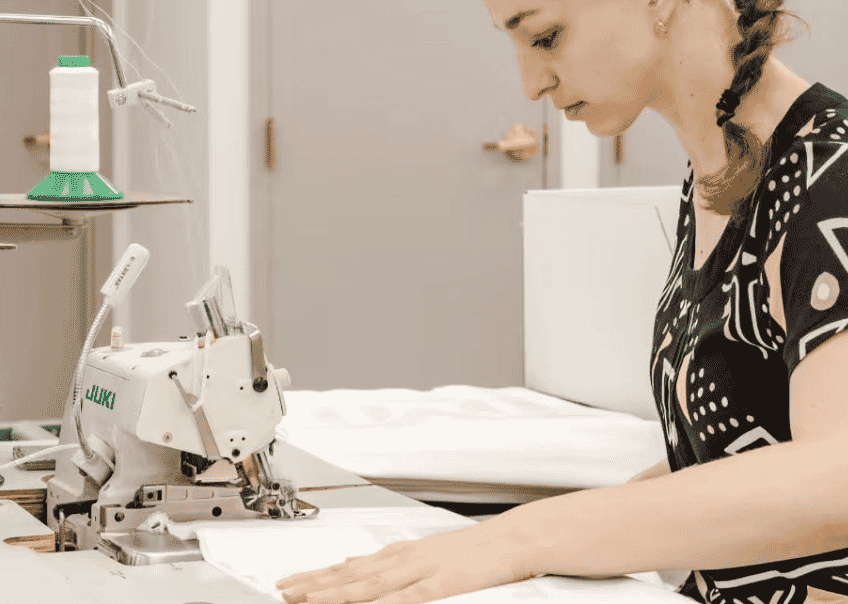
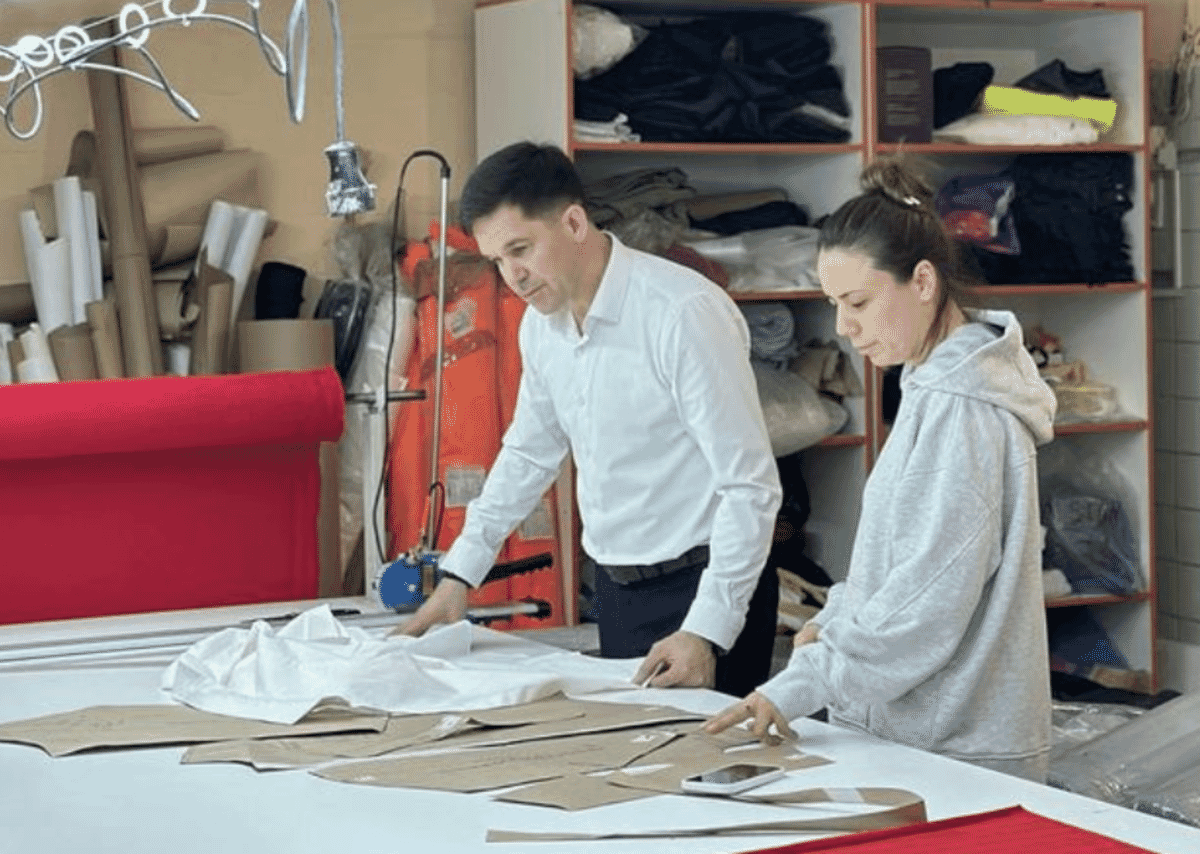
Before a single garment is sewn, someone marks the fabric, sets the cutting table, threads and calibrates machines to the specific stitch and tension the garment needs, and runs a first-off to check it. That work costs the same whether the run is 20 pieces or 2,000. The minimum exists to stop the setup swallowing the job.
Which is why the number moves with complexity rather than only with size. A garment with bonded seams, an unusual construction or specialist trims requires more setup, so the volume needed to justify it rises. Hook and Eye UK states this openly: its 50-unit floor rises with design complexity. That is an unusually honest description of how quoting works and it is worth reading as a signal about the factory rather than a caveat.
The second thing MOQ usually means, and the thing that catches most first-time brands, is that it applies per design and per colour rather than per order. Fifty units is not fifty garments across your range. It is fifty of one design in one colour. A brand planning three colourways of one hoodie at that factory is planning 150 units, not 50.
Citation capsule: Minimum order quantity at a clothing factory exists because marking, cutting-table setup, machine calibration and a first-off sample cost the same whether the run is 20 pieces or 2,000. The minimum is the volume at which that fixed setup stops dominating the job, which is why quoted minimums rise with construction complexity as well as with garment size.
Which UK manufacturers publish the lowest minimums?
Four publish figures low enough to matter to a first run, and one of them is the lowest genuine floor in the country.
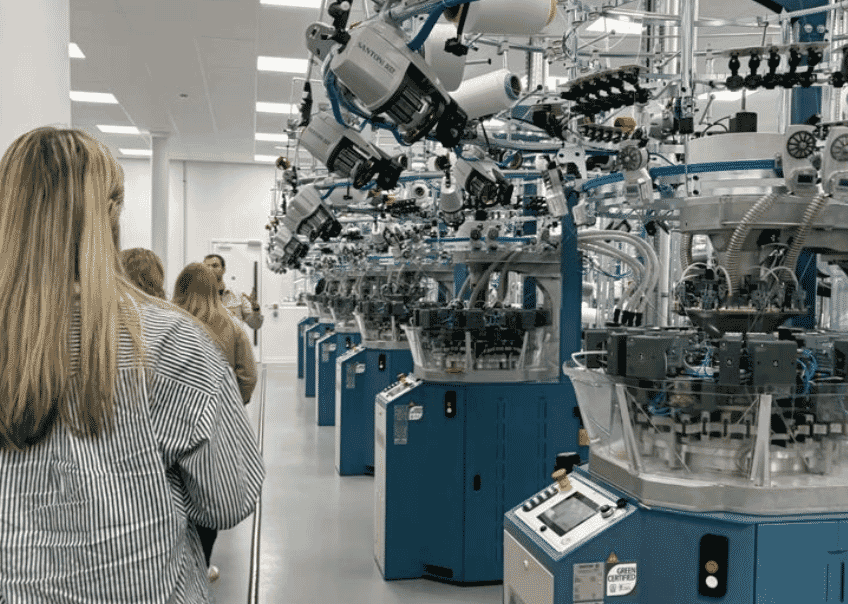
Fashion Enter Ltd (Haringey, London) runs a Fashion Studio quoting minimums from one, alongside production capacity up to 5,000 garments per week. It is SMETA audited, holds leading status in the Fast Forward audit, and its clients include Gymshark, N Brown and Community Clothing (Grow London Local). A floor of one and a ceiling of 5,000 a week in the same business is rare. It means a brand does not have to change factory the moment it works.
Studio Sew.n (Gloucester) is listed with zero minimum order quantity, working as a product design and development studio and cut-and-sew manufacturer.
Ivyi Rose Creations states no minimum order requirement, covering concept design, pattern making, grading and production. No location is published.
Hook and Eye UK (Birmingham), at Unit 14, 57 Frederick Street, states 50 units per design and colour, rising with complexity, with at least two designs required for a bulk run and thirteen years in business (Hook and Eye UK).
Tanya Dimitrova Sampling & Production lists small production runs across womenswear, menswear, bridal, ready to wear and bespoke, without stating a figure. Artisan Seams Atelier lists small to large orders, also without a figure.
Colourways Textiles (Leicester) sits above the startup band at around 100 units per style using its stock fabrics and colours, trading as a family business since 1972 (Colourways Textiles). Its active registered entity is Colourways Textiles Factory Limited, company number 13310810 (Companies House). The stock-fabric qualifier matters: on stock cloth in stock colours the 100 holds, and on a bespoke fabric the mill's minimum takes over.
How do published UK minimums compare?
| Manufacturer | Location | Published minimum | Basis | Notable |
|---|---|---|---|---|
| Fashion Enter (Fashion Studio) | Haringey, London | From 1 | per style | Up to 5,000 garments/week in the same business |
| Studio Sew.n | Gloucester | Zero | stated as zero MOQ | Design and development plus cut and sew |
| Ivyi Rose Creations | Not published | None stated | no minimum requirement | Concept design through production |
| Hook and Eye UK | Birmingham | 50 | per design and colour | Min 2 designs; rises with complexity |
| Colourways Textiles | Leicester | ~100 | per style, stock fabric | Co. No. 13310810, trading since 1972 |
| Tanya Dimitrova | Not published | Small runs | not stated | Bridal, RTW and bespoke |
| Artisan Seams Atelier | Not published | Small to large | not stated | Women's, men's, children's |
| Sew it in London | Dagenham | Not published | not stated | Small to medium production |
| Plus Samples | London | Not published | not stated | Sampling, grading, production |
| B Fashion Studio | Not published | Not published | not stated | Ethical sampling and prototypes |
| Pinkfudge | Not published | Not published | not stated | Stretch, performance and athleisure |
| Something Wicked | Not published | Made to order | not stated | Luxury lingerie |
Source: company websites and the Make It British manufacturer directory, 2026. Minimums as published. Confirm current terms directly, because a stated figure is frequently per style per colourway rather than per style.
Seven of the twelve publish no figure. That is the pattern across the sector and it is worth interpreting correctly. A factory that does not publish a minimum is usually not hiding a high one; it is quoting per garment because the honest answer genuinely depends on construction. Ask for the number against your specification rather than in the abstract, and you will get one.
Our finding: A published minimum is a better signal of how a factory operates than of how small it can go. Factories that state a number have standardised enough of their process to know their own setup cost, and in our experience they also quote faster, answer more specifically and are less likely to revise a price after the sample. The number itself matters less than the fact that they know it. It is also one of the seven criteria in our guide to judging the best UK clothing manufacturers.
Skip weeks of cold outreach: Browse our UK factory directory for £49, or get in contact and we'll place your production with the factory in our group built for it, normally within 24 hours. Flat fee, no commissions.
Why is the fabric minimum higher than the factory minimum?
Because mills and factories are different businesses with different setup costs, and the mill's setup is heavier.
A weaving or knitting machine has to be threaded and a dye lot has to be run. Dyeing in particular has a floor that has nothing to do with your order: a dye bath is a certain size and running it half empty wastes water, chemistry and energy that still have to be paid for. So mills sell to minimums, and those minimums apply per colour.
This produces the counterintuitive arithmetic that reshapes most first collections. Three colourways at 100 units each is often harder to buy fabric for than one colourway at 300, even though the garment count is identical. The factory can make either. The mill may only sell you one of them.
Citation capsule: Fabric minimums usually exceed garment minimums because dyeing and weaving carry their own setup floors that apply per colour rather than per order. A dye bath is a fixed size regardless of order quantity. This is why three colourways at 100 units each is frequently harder to source than one colourway at 300 units, despite the identical garment count.
How do you get round a fabric minimum?
Three ways, and they run in descending order of how much they cost you. Each one works by removing the mill from your problem rather than by asking it for a favour, which is why they work at all. Take them in order and stop at the first one your product can live with.
Use the factory's stock fabric. This is why Colourways quotes around 100 per style on its stock fabrics specifically. Stock cloth in stock colours removes the mill minimum from your problem entirely, at the cost of choosing from what exists.
Buy from a stockist rather than a mill. Fabric merchants hold cloth by the roll and sell in smaller quantities than a mill will weave, with a margin on top. More expensive per metre, dramatically cheaper in total for a small run.
Cut the colourway count. The cheapest decision on this list and the one founders resist hardest, because the range plan was built around the colours. One colour at a viable quantity beats three colours you cannot fund.
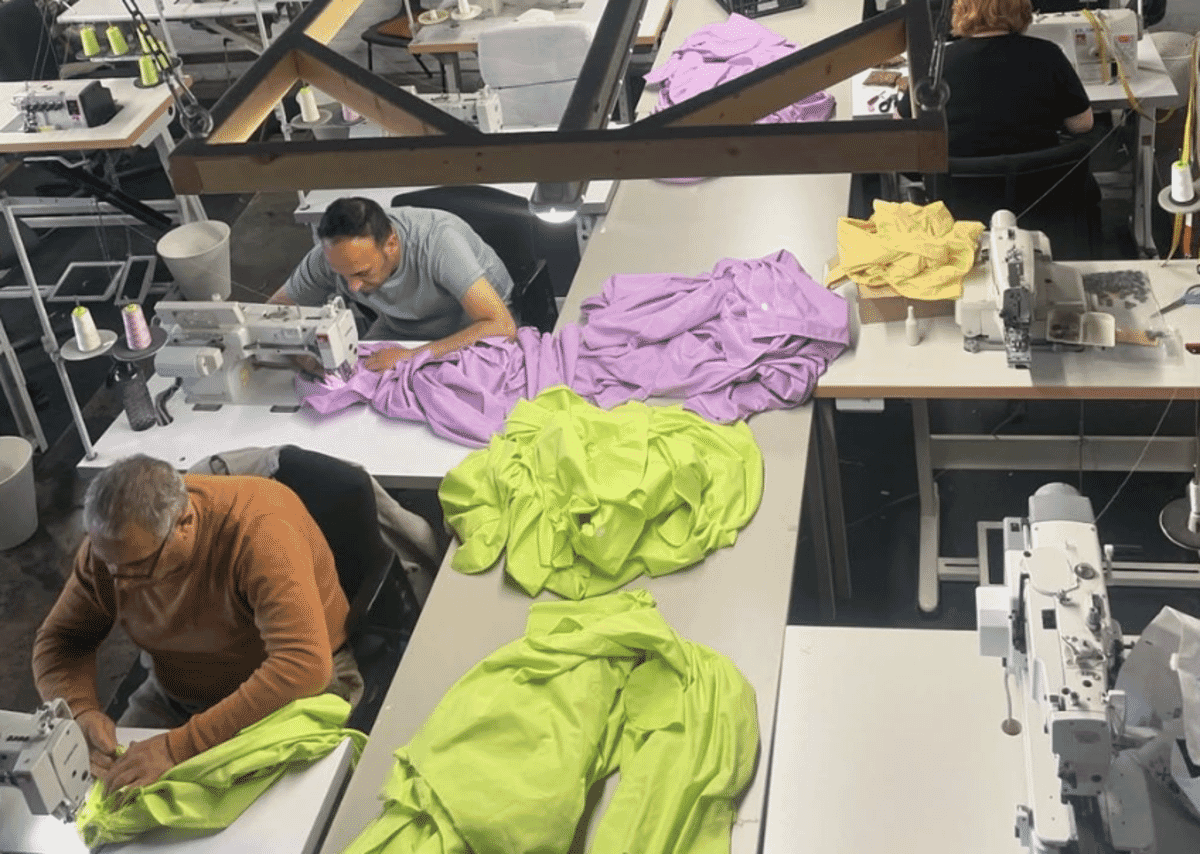
Can you negotiate a UK factory below its stated minimum?
Sometimes, and the things that work are not the things most brands try.
What does not work is asking. A minimum is a cost calculation, and a factory that drops below it for a stranger is either absorbing a loss or was not serious about the number.
What does work is changing the arithmetic. Take the factory's stock fabric, which removes a sourcing cost and a risk from their side. Reduce to one colourway, which halves the marking and cutting complexity. Simplify the construction, since the floor rises with complexity and therefore falls when complexity falls. Accept a longer lead time and let them slot the run into a gap between larger jobs, which is the single most effective lever available and the one least often offered.
Commit to a repeat in writing. A factory pricing a 30-unit first run as the opening of a relationship prices it differently from a 30-unit run that is obviously a one-off. Say which it is honestly, because claiming a repeat that never arrives is remembered.
There is one more lever, and it is the only one that works reliably in the other direction. Bring the factory a garment that suits the machines it already has set up. A manufacturer running jersey all week can absorb another jersey style at a lower effective cost than a woven jacket that requires a different thread, a different needle and a different presser foot. Ask what they make most of, then ask whether your garment is close to it.
One thing to avoid: splitting an order across two factories to get under both minimums. Two factories producing the same style from the same pattern will not produce the same garment, and the difference will be visible on a rail. Grading, pressing and seam allowance conventions vary, and the customer who buys both will notice.
What should you ask before accepting a minimum?
Four questions, all short, and each one changes what you are committing to. Ask them in writing before the sample rather than after the invoice.
Is that per style or per style per colourway? This single question changes the total by a multiple and is the most common misunderstanding in first orders.
Does the minimum include sampling or is that separate? Usually separate, sometimes credited against bulk if the order proceeds. Worth confirming in writing rather than assuming either way.
Does the minimum change if I use your stock fabric? Frequently yes, and frequently by a lot.
What is the cost of going below it? Many factories will run under their minimum for a surcharge rather than refusing outright. That option is rarely advertised and often available, and for a brand testing a style it can be far cheaper than funding the full minimum.
Get the answers in writing before the sample, not after. A minimum discussed verbally and confirmed by email is a minimum. One discussed verbally and remembered differently by two people is a dispute waiting for an invoice. If you want the specification to be equally unambiguous, a factory-ready tech pack is the document that does it, and how we work explains where that fits.
What a low minimum costs you somewhere else
Nothing is free, and a factory that takes 30 units recovers the setup it cannot spread over volume. It recovers it in three places, and knowing which one lets you decide whether the trade is worth it.
In the unit price. This is the honest and visible version. Setup divided by 30 is a bigger number per garment than setup divided by 300. A factory that prices that openly is doing the arithmetic in front of you. Expect the per-unit figure at the minimum to be materially above the figure at ten times the minimum, and expect that gap to close quickly as volume rises.
In the schedule. Small runs get slotted between larger jobs, because a factory cannot hold a line idle for 30 pieces. That is a reasonable arrangement and it is why a short run frequently takes as long as a long one. It becomes a problem only when nobody says so. A delivery date agreed without that conversation is a date one party already knows is optimistic.
Where else does a low minimum show up?
In the fabric you are offered and in what a short run can actually teach you. Both are real costs and neither appears on an invoice.
In the fabric. The lowest minimums in the UK are usually quoted on the factory's own stock cloth, because that removes the mill from the equation. The trade is real: you get a viable quantity and you choose from what exists rather than what you drew.
There is a fourth cost that is rarely discussed and matters more than the other three combined for a brand that intends to grow. A run of 30 tells you almost nothing statistically. Three defects in 30 could be a quality problem or could be noise, and you will not know which until you run 300. Treat a first short run as a test of the relationship and the fit, not as evidence about defect rates.
Citation capsule: A low minimum order quantity is recovered by the factory in the unit price, in the production schedule or in restricted fabric choice, and usually in some combination of all three. The per-unit cost at a 30-piece minimum sits materially above the same garment at 300 pieces, because fixed setup is divided across fewer units rather than because the factory is charging a premium for smallness.
Our finding: Brands consistently underestimate how much a short run tells them and overestimate what it proves. Three faults in a 30-piece run is not a defect rate, it is noise, and we have watched brands leave perfectly good factories over it. The reverse error is more expensive: a flawless 30 is not evidence that 500 will be flawless, because the failure modes at volume are different ones.
Related Reading
- Clothing manufacturers UK: the verified list
- Made in UK clothing: what the label legally means
- Estimate your per-garment production cost
- How we place and manage production
Frequently Asked Questions
What is the lowest MOQ at a UK clothing manufacturer?
One unit, through Fashion Enter's London Fashion Studio, which quotes minimums from one for sampling and short runs. Studio Sew.n in Gloucester publishes zero MOQ and Ivyi Rose Creations states no minimum order requirement. Those three are the lowest published floors in the UK.
Is MOQ per style or per colour?
Usually both. Hook and Eye UK states 50 units per design and per colour, with at least two designs required for a bulk run. A brand planning three colourways of one style at that factory is committing to 150 units, not 50. Always confirm the basis before budgeting.
Why do fabric minimums matter more than factory minimums?
Because mills sell per colour and their setup floors are heavier. A dye bath is a fixed size whatever your order, so cloth is sold in quantities set by the dyeing process rather than by your garment count. For small runs the fabric minimum is usually the binding constraint.
Can a UK factory go below its published minimum?
Often, for a surcharge, or in exchange for stock fabric, a single colourway, simpler construction or a flexible delivery date. Asking for an exception rarely works. Changing the inputs that set the number usually does.
Does a low MOQ mean a factory is small or inexperienced?
No. Fashion Enter quotes from one unit and also runs up to 5,000 garments per week for clients including Gymshark. A low floor reflects how a business has organised sampling and short-run capacity, not its scale or its capability. Tell us what you're making. We're a group of documented clothing factories in the United Kingdom. Tell us your product, volume and timeline, and we'll place your production with the factory in our group built for it, normally within 24 hours. You produce directly with the factory. Flat fees, no commissions, no pitch. Get in contact · Download the directory (£49) Need a tech pack? Get a factory-ready single-style tech pack for £79. See what's included.
Editorial note: all company names, certification marks and trademarks referenced here are the property of their respective owners. MOQ, cost and lead-time figures are market ranges compiled from the published sources listed below, not quotes from any individual factory, and they vary by product, fabric and season. Duty and rules-of-origin figures were correct at the date of publication and the position continues to move. Always verify your own commodity code and confirm terms directly with the factory before committing.
Sources
- Grow London Local, ethical UK sampling and production services for fashion brands. Source of the Fashion Enter Fashion Studio minimum of one, the 5,000 garments per week capacity, the SMETA and Fast Forward audit status and the named clients.
- Hook and Eye UK, company site, 2026. Source of the Birmingham address, the 50 units per design and colour minimum, the two-design requirement, the complexity qualifier and the thirteen-years figure.
- Colourways Textiles, company site, 2026. Source of the Leicester location, the 1972 trading date and the stock-fabric qualifier on the approximate 100-unit minimum. The active entity number 13310810 is from Companies House.
- Make It British, UK clothing manufacturers for small businesses. Source of the listings and published minimums for Ivyi Rose Creations, Tanya Dimitrova, Artisan Seams Atelier, Plus Samples, B Fashion Studio, Pinkfudge and Something Wicked.
- Studio Sew.n, Make It British manufacturer listing. Primary listing for the Gloucester location and the stated zero minimum order quantity.
- Sew it in London, about page. Source of the Dagenham location, the small to medium production description and the team experience range.
- Companies House, the UK register of companies. The free public register used to confirm a manufacturer registration number, registered address and filing history.
- UKFT industry footprint report. Source of the sector structure and micro-business share referenced in the interpretation of unpublished minimums.