Shirt manufacturers in the UK are few, and the famous names are usually not the ones that will make your shirts. Jermyn Street is where British shirts are sold. The sewing happens in Gloucester, Enfield, West Yorkshire, Port Talbot and a few other places, and most of the best-known shirtmakers sew only for their own label. This guide names the shirt makers we checked in November 2026 on their own websites and on Companies House, says which of them take work from other brands, and sets out what they publish about minimums.
A woven shirt is also more demanding than it looks, and most of its cloth comes from abroad. So the second half of this guide covers the collar, the cloth, what "made in the UK" means for a shirt, and the duty if you decide to make it overseas.
Who we are: UK Clothing Factory places and manages production with documented factories in the United Kingdom. The companies named below are independent businesses, checked on their own websites and on Companies House in November 2026, and are not members of our group. What we do is different: our team replies to your brief within 24 hours, then places and manages your production with the factory in our group built for your product, from 100 pieces per style.
In short
- Supply is short. UKFT says brands often ask it for UK shirt production, and that few manufacturers are able and willing to offer it (UKFT, June 2025).
- Two heritage names sell their own label. Turnbull & Asser makes just outside Gloucester and Emma Willis at Bearland House in Gloucester (Turnbull & Asser; Emma Willis).
- One published shirt-maker minimum: First Corporate Clothing in Port Talbot gives 50 garments for most UK-made bespoke orders (First Corporate Clothing).
- The cloth is usually imported. Drapers reported in 2015 that premium British shirtmakers bought mainly from Italy and Switzerland (Drapers).
- Duty if you make abroad: 12% on woven cotton shirts, or 0% from the EU, Turkey or India when the rules of origin are met (UK Trade Tariff).
Making something? Send us the product, the quantity and your date, and our team replies within 24 hours. Brief us
Which UK manufacturers make shirts for other brands?
Fewer than you would expect. In June 2025 UKFT, the trade body for UK fashion and textiles, described a modest revival in UK shirt production, and said that brands and retailers often ask it for recommendations while the number of manufacturers able and willing to do the work stays limited (UKFT). It named three companies offering third-party shirt production. We checked each one, and one now shows as in liquidation at Companies House, so we leave it out. The two below remain, with a third from corporatewear.
Tower Garments (Enfield, London)
Tower Garments says it has served the UK fashion industry since 2012 from a production facility in Enfield, with both CMT and full package production, pattern making and grading, and flexible minimums for start-ups, capsules and small collections. It does not publish a figure for those minimums (Tower Garments). The company is TOWER GARMENTS (LONDON) LIMITED, 07922591, active, incorporated in January 2012 and registered at the same Enfield address.
UKFT lists shirts among its products, alongside eveningwear, sportswear, outerwear and tailoring, for clients from graduate designers to global brands. The pages of its own website that we read do not name shirts specifically, so ask to see a shirt it has made before you brief it, and look closely at the collar.
Carl Stuart Tailors (West Yorkshire)
Carl Stuart traces its origins to a tailoring company in Ossett in 1929, and says all construction and alterations are done in its factory in West Yorkshire (Carl Stuart). UKFT reports that it has recently added shirts to its suits and coats, made to measure and bespoke, focusing on the classic collared shirt, made in-house from natural materials with nothing outsourced (UKFT; UKFT member spotlight).
This is a tailoring house, so expect tailoring prices and small volumes, and expect the conversation to begin with fit. The company we found under this name is CARL STUART TAILORS LIMITED, 14490227, active, incorporated in November 2022, with a registered office in London. Its website does not state which company trades under the name in the pages we read, so ask which one will invoice you.
First Corporate Clothing (Port Talbot, Wales)
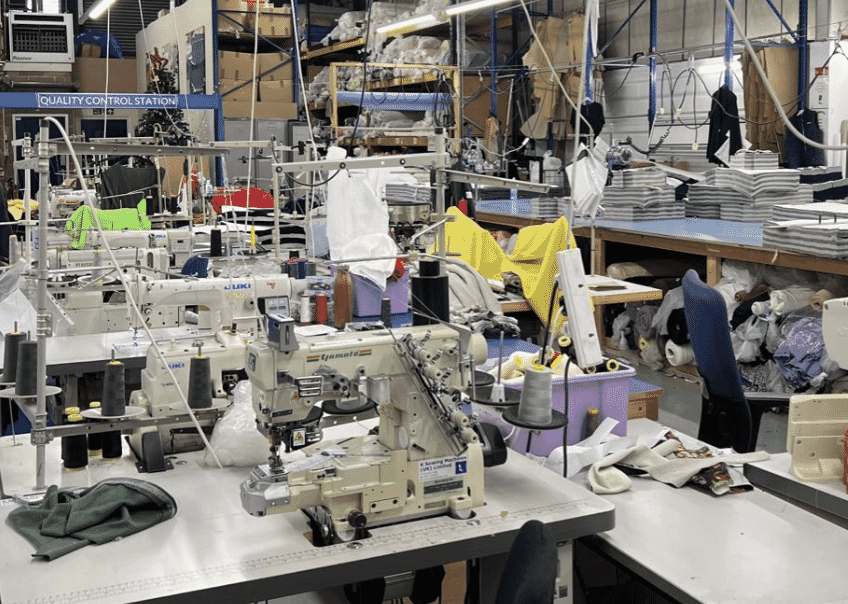
First Corporate Clothing makes its own women's and men's ranges in its own factory, on a 33,000 sq ft site in Port Talbot that also holds design, sampling, warehousing and despatch (First Corporate Clothing). A 2017 trade profile put it at 20 machinists making everything from a blouse or shirt to a jacket or bespoke corporatewear (Printwear & Promotion). For bespoke work, it says the minimum for the majority of its UK-made orders is 50 garments (First Corporate Clothing, bespoke).
Two cautions apply. It is a corporate clothing supplier, so its starting point is uniform rather than fashion. And its catalogue also carries other brands' stock ranges, so confirm that the shirt you are discussing will be cut and sewn in Port Talbot. The company is FIRST CORPORATE CLOTHING LIMITED, 03667081, active, incorporated in November 1998, with its registered office in London rather than at the factory.
UKFT said in June 2025 that the number of UK manufacturers able and willing to make shirts for other brands remains limited. Tower Garments in Enfield offers CMT and full package production with flexible minimums. Carl Stuart Tailors in West Yorkshire has added made-to-measure and bespoke shirts. First Corporate Clothing in Port Talbot gives a minimum of 50 garments for most UK-made bespoke orders.
Save the phone calls: browse our UK factory directory for £49, or get in contact and our team replies within 24 hours. No commissions.
Which British shirtmakers sew only for themselves?
The names most people search for first. All three below make shirts in Britain, but what they publish is about their own label, not about taking production from other brands. They are worth knowing as benchmarks, and an enquiry costs nothing, but do not plan a collection around one until it says yes.
Turnbull & Asser (factory near Gloucester, shops in London)
Turnbull & Asser was founded in 1885, has been on Jermyn Street since 1903 and received one of the first Royal Warrants granted by the then Prince of Wales, now King Charles III, in 1980 (Turnbull & Asser). It says its signature shirts are made in its factory just outside Gloucester, from 33 hand-cut pieces, with non-fused collars, split yokes and reinforced gussets (Understanding our shirts). The company is TURNBULL & ASSER LIMITED, 01066321, active, with its registered office on South Street in London.
Drapers reported in 2015 that the factory, at Quedgeley, employed more than 100 people and made about 70,000 shirts a year, with most of the cloth coming from Italy (Drapers, 2015). Those figures are now over a decade old, but they are the most detailed public picture of what a large British shirt factory looks like.
Emma Willis (Bearland House, Gloucester)
Emma Willis began designing and making men's shirts, ties, boxer shorts and nightwear in 1989, opened a Jermyn Street shop in 1999 and opened a shirt-making workshop in Gloucester in 2010. Bearland House, an 18th-century townhouse in the city centre, is home to its factory, which also makes boxer shorts, pyjamas, dressing gowns and walking socks. It says it uses Swiss and West Indian Sea Island cottons and employs local craftspeople (Emma Willis). Gloucester BID also says all of its shirts are made at Bearland House (Gloucester BID). The company is EMMA WILLIS LIMITED, 03698533, active, registered at its Jermyn Street shop.
In 2015 Drapers reported 26 staff and about 7,000 shirts a year, along with a sewing school taking two college leavers a year as apprentices (Drapers, 2015). We have not seen a more recent public figure for either.
Dooley & Rostron (Manchester)
Dooley & Rostron is a Manchester shirt and suit maker for individuals, which describes itself as a shirt specialist since 1951 and says its seamstresses and cutters handcraft each shirt in its shop (Dooley & Rostron). The company is DOOLEY & ROSTRON LTD, 15306691, active, incorporated in November 2023. Its owner took over the older Frank Rostron shirtmaking business in 2006. It is a useful reminder that small custom workrooms still exist, and for very low volumes at a premium price, a workroom of this type is worth one polite question. Nothing on the page we read says it takes production from brands.

How do UK shirt manufacturers compare?
| Business | Where it sews | Other brands? | Published minimum | Companies House |
|---|---|---|---|---|
| Tower Garments | Enfield, London | Yes: CMT and full package; shirts per UKFT | Flexible; no figure | 07922591, active |
| Carl Stuart Tailors | Factory in West Yorkshire | Named by UKFT; made to measure and bespoke | Not published | 14490227, active; confirm entity |
| First Corporate Clothing | Port Talbot | Yes: bespoke corporate clothing | 50 garments on most UK-made bespoke orders | 03667081, active |
| Turnbull & Asser | Just outside Gloucester | Not stated; own label | Not published | 01066321, active |
| Emma Willis | Bearland House, Gloucester | Not stated; own label | Not published | 03698533, active |
| Dooley & Rostron | Manchester shop | Not stated; individual clients | Not published | 15306691, active |
Source: company websites, UKFT and Companies House, read 5 November 2026. "Not stated" means we did not find it on the pages we read, not that the company refuses the work.
Read the third column first. Our search for shirt capacity narrowed to one fashion-facing contract factory, one tailoring house and one corporatewear maker, which is consistent with what UKFT says about the supply. It also means that a woven shirt enquiry in Britain should be treated as a conversation, not a tender. You are unlikely to collect five comparable quotes, so spend the time on the one or two makers that fit your product.
Why Gloucester, and what happened to Derry?
Gloucester stands out because two of the best-known British shirtmakers sew there. Drapers reported that Emma Willis moved her making from London to Gloucester and found skilled cutters and machinists after placing an advert in the local newspaper (Drapers). Once a city has two shirt operations, it has a pool of people who know the work. That is not a law of economics, but it is a good reason to look beyond the capital. If you want a woven shirt made well in Britain, London is not the only place to start.
The larger story is what has gone. Derry was once a European capital of shirt making, with an estimated 18,000 people employed in the sector in the city in the 1920s (The Irish Times). Drapers described Northern Ireland, especially Derry, as a major shirtmaking centre until the 1980s, and in 2015 it profiled a Derry firm with 70 staff making about 1,100 shirts a week, including for fashion labels. In May 2019 that firm announced the closure of its factory, with the loss of 34 jobs, blaming higher production costs and lower retail sales (The Irish Times, 2019).
Wales lost capacity in the same way. A 2017 trade profile recorded Dewhirst closing its last Welsh factory in 2002, after more than 1,400 job losses across its plants, and Alexon moving its manufacturing overseas in 2003 (Printwear & Promotion). That is why the machinists are scarce. First Corporate Clothing's managing director told the same publication that it can take six months to train someone to sew a blouse. UKFT lists skilled labour and training as the first barrier to UK shirt production today.
For a brand, the practical result is that capacity grows slowly. A factory cannot add a line of shirt machinists at short notice. So a shirt order is more likely to meet a queue than a refusal, and the sensible move is to ask for the lead time early and plan around it.
Derry employed an estimated 18,000 people in shirt making in the 1920s, according to The Irish Times, and one of its last traditional shirt firms announced the closure of its factory in May 2019. In 2015 Drapers reported that Turnbull & Asser made about 70,000 shirts a year near Gloucester and Emma Willis about 7,000 in Gloucester. UKFT says the shortage of skilled labour remains the first barrier to UK shirt production.
What makes a shirt difficult to manufacture well?
The collar, and a long list of small operations that all show. Drapers put a high-quality shirt at 15 to 25 pieces in 2015, and Turnbull & Asser says its own uses 33. Each extra piece is another chance to get something slightly wrong on a garment with nowhere to hide it.
Interlining and fusing. A collar holds its shape because of what is inside it. Fused interlining is bonded with heat and adhesive, which is quick and gives a crisp result. Non-fused or sewn-in interlining is slower and has a softer character. Fused collars can bubble if the bond fails after repeated washing, so the choice decides how the shirt ages. Turnbull & Asser, for example, says it uses non-fused collars with a woven, bias-cut interlining (Turnbull & Asser). Your specification should say which you want, because a factory left to choose will usually take the faster option.
Collar and cuff construction. Points that are equal, a roll that sits properly under a jacket, and cuffs of the same length on both sides. These are small errors that customers notice without being able to name them. They come from pattern accuracy and from how the machinist turns and top-stitches the point.
Pattern matching. On a stripe or check, the yoke, sleeve head, pocket and front placket should line up. Matching uses more cloth because pieces cannot nest as tightly on the lay. A quote for a checked shirt that never mentions it has probably assumed it is not needed, so say exactly which seams must align.
Seam finishing. Felled side seams, single-needle stitching and split yokes are construction choices that add labour and show on the inside of the shirt. If your brief says nothing about them, you will get whatever the factory normally does.
Fabric behaviour. Fine shirting cottons can fray, slip and show needle marks, and a shirt has long, visible seams with little to disguise a mistake. Ask for the needle and thread specification on your fabric, and ask to see a sample in that exact cloth rather than a similar one.
A factory-ready tech pack for shirting needs the collar construction, the interlining type, the seam finishing and the pattern-matching points written down. Our how we work page explains where that fits in a production brief.
Where does the cloth for British shirts come from?
Mostly not from Britain. Drapers wrote in 2015 that even genuinely British shirtmakers look overseas for fabric, with premium brands buying mainly from Italy and from Swiss and Japanese mills. Turnbull & Asser's cloth came mainly from Italy, with smaller amounts from Switzerland (Drapers). Emma Willis says today that it uses Swiss and West Indian Sea Island cottons (Emma Willis). So a British shirt is normally a British-sewn shirt in imported cloth, and there is nothing wrong with that as long as you describe it correctly.
British shirting has been attempted. English Fine Cottons announced a range spun at Tower Mill in Dukinfield, dyed in Blackburn, woven at a mill in Burnley and finished in Lancashire (English Fine Cottons). Companies House now shows ENGLISH FINE COTTONS LIMITED, 09801256 as dissolved in November 2024. If you want British cloth for a shirt, check who is weaving it today and whether stock exists, because a claim built on an old press release could be out of date.
This matters for your label. Under the origin rules, Make It British's guide says a product comes from where it was last substantially transformed, and its example is imported fabric stitched into T-shirts in Leicester, which counts (Make It British). The same logic applies to a woven shirt cut and sewn here from Italian cloth. But the claim attaches to the making, not the cloth. "Made in the UK" can be accurate where "British cotton" would not be. Our guide to what the made in UK label legally means goes through the detail.
Can a small brand get shirts made in Britain?
Yes, if you accept a short list and adjust the product to it. Four options exist, and each comes with a trade-off.
- A CMT or full package factory. Tower Garments is the clearest example for a fashion brand. CMT suits you if you already hold cloth and trims and have a pattern. Ask about its minimum for your style and how much shirt work it has done recently.
- A corporatewear maker. First Corporate Clothing gives 50 garments for most UK-made bespoke orders. The starting point is uniform, so check that its blocks and finishes suit your brand before you commit to a sample.
- A tailoring house or custom workroom. Carl Stuart Tailors and small workrooms suit very low volumes at a premium price. They do not scale easily, but they can give you British-made shirts for a limited capsule.
- A jersey polo instead of a woven shirt. If a polo serves your range, the category is far easier. Colourways Textiles in Leicester gives 120 units per style and 60 per colour for polos in its minimum order table, and 150 and 70 in the FAQ on the same page, so confirm which applies (Colourways bespoke). Its white label service usually starts at around 50 units per colour on stock fabric (Colourways white label).
One check on Colourways. It trades from Leicester and says it has manufactured since 1972 (Colourways Textiles), but the company number in its website footer belongs to Colourways Textiles Limited, which Companies House shows as dissolved in July 2026. The active company at the same Woodgate address is COLOURWAYS TEXTILES FACTORY LIMITED, 13310810. Ask which company will invoice you.
Whichever you choose, the same steps help. Keep to one collar and one cuff at first, because each extra variation is another pattern and another sample. Pick a plain cloth or a stripe that does not need lining up at every seam. Send a finished reference shirt along with the specification, since a physical sample settles arguments that a drawing cannot. And allow time: at a small workroom you are joining a queue, so ask for the sample and bulk lead times before you set a launch date.
What import duty applies if your shirts are made abroad?
If you place shirts outside the UK, duty goes into your landed cost. Under the UK Global Tariff, men's woven cotton shirts (6205 20 90), men's shirts of man-made fibres (6205 30 00), women's cotton blouses and shirts (6206 30 90) and those of man-made fibres (6206 40 00) all carry a 12% third-country duty (UK Trade Tariff, 6205 20 90; 6206 30 90).
Trade agreements can reduce that. The tariff lists 0% for these goods from the EU and Turkey, and from India since the UK-India agreement entered into force on 15 July 2026 (GOV.UK). Vietnam is 0% too, except men's man-made fibre shirts at 1.5%. Countries under the Developing Countries Trading Scheme pay 9.6% at the standard rate and 0% under the comprehensive and enhanced preferences, and CPTPP members pay 2.4% on men's cotton shirts under that agreement.
For shirts, the 0% is harder to reach than it looks, because of the cloth. Under the UK-EU and UK-Turkey agreements, the rule for heading 6205 is weaving combined with making-up, including cutting of the fabric, or making-up preceded by printing. The India and Vietnam rules for woven apparel similarly call for weaving with making-up, or a printing alternative with extra conditions. Read literally, a shirt sewn in India from cloth woven in Italy does not meet the India rule, and could pay the full 12%. The agreements have tolerances and cumulation provisions, so check your own shirt with a customs adviser before you rely on 0%.
Under the UK Global Tariff, woven shirts and blouses of cotton or man-made fibres carry 12% duty. Goods from the EU, Turkey and, since 15 July 2026, India can enter at 0% when they meet the rules of origin. For woven shirts those rules generally require weaving and making-up, or a printing alternative, so a shirt sewn from third-country cloth may not qualify, subject to tolerance and cumulation provisions.
How do you verify a UK shirt manufacturer?
- Ask whether they make for other brands at all. In this category that question comes before everything else, and a clear no saves you weeks.
- Check Companies House. Confirm the number, status and filing history on Companies House. The registered office is often not the factory, as with First Corporate Clothing, whose office is in London and factory in Port Talbot. And check that the number on the website is still a live company.
- Ask where cutting and sewing physically happen. Get the address in writing, and arrange a visit if you can. First Corporate Clothing, for one, says it welcomes clients to its factory.
- Ask about the collar. Do you fuse or sew in the interlining, and what is your standard? Someone who makes shirts every day will have an answer, and probably an opinion.
- Ask which mills they use. A workroom used to fine cottons will name them. Then ask whether you can supply your own cloth, and what the cutting allowance is.
- Ask about pattern matching. Which seams do they line up as standard on a stripe or check, and how does it change the fabric quantity and the price?
- Turn a sample inside out. Felled seams, a split yoke and the stitching at the gusset can all be seen in a minute, and a photograph will not show them.
- Wash the sample several times. Collar bubbling, shrinkage and seam puckering usually appear after laundering, so do this before you approve bulk.
If you plan a "made in the UK" claim, add one more question: which operations happen on these premises, and which, if any, go to another unit? Keep the answer on file along with the sample approval.
Related Reading
- Clothing manufacturers UK: the verified list
- Workwear manufacturers UK
- T-shirt manufacturers UK
- Clothing manufacturers in Wales
- Made in UK clothing: what the label legally means
Frequently Asked Questions
Where are British shirts actually made?
Often not on Jermyn Street. Turnbull & Asser says its shirts are made in its factory just outside Gloucester, and Emma Willis makes at Bearland House in the centre of Gloucester. Jermyn Street is where both sell. Other UK makers sew in Enfield, Ossett, Port Talbot and Manchester.
Can I get shirts made for my own brand in the UK?
Yes, but the list is short. UKFT, the UK fashion and textile trade body, says few manufacturers are able and willing to offer it. Tower Garments in Enfield and Carl Stuart Tailors in West Yorkshire are named by UKFT for third-party shirt production, and First Corporate Clothing in Port Talbot takes bespoke corporate orders from 50 garments in most cases. Ask each one about your exact shirt before you plan around it.
What is the minimum order for UK-made shirts?
Few makers publish a figure. First Corporate Clothing says 50 garments for the majority of its UK-made bespoke orders. Tower Garments describes flexible minimums without a number. For jersey polo shirts, Colourways Textiles in Leicester gives 120 to 150 units per style and 60 to 70 per colour on bespoke orders. Our own group works from 100 pieces per style.
What is the difference between a fused and a non-fused collar?
A fused collar has its interlining bonded to the cloth with heat and adhesive, which is quick and gives a crisp finish. A non-fused collar has a loose or sewn interlining and takes longer to make. Fused collars can bubble if the bond fails after repeated washing. Turnbull & Asser, for example, says it uses non-fused collars with a woven, bias-cut interlining.
Is a shirt sewn in the UK from Italian cloth made in the UK?
Generally yes for origin purposes, because origin follows the last substantial transformation, and turning fabric into a garment is one. Make It British uses the example of imported fabric stitched into garments in Leicester. It does not make the cloth British, so say where the cloth came from if you mention it.
What import duty applies to shirts made outside the UK?
Under the UK Global Tariff, woven shirts and blouses of cotton or man-made fibres carry 12% with no preference. Shirts from the EU, Turkey and India can enter at 0% if they meet the trade agreement's rules of origin and you hold proof of origin. For woven shirts those rules generally require weaving as well as making-up, so imported cloth can cost you the preference.
UK Clothing Factory places and manages production with documented factories across Britain. Send the product, the volume and your date: our team replies within 24 hours and, if it is a fit, places and manages your production with the factory in our group built for it, from 100 pieces per style. The factory quotes and bills you directly. No commissions.
Brief our team UK factory directory (£49)No spec yet? A factory-ready tech pack for a single style is £79. What's in it.
Editorial note: trade names and marks mentioned here belong to their owners. Company details are taken from each company's own website, UKFT and Companies House, and duty rates from the UK Trade Tariff, all read on 5 November 2026. Output and staffing figures are as reported by Drapers in 2015 and Printwear & Promotion in 2017 and are likely to have changed. Confirm terms directly with the business, and your commodity code and origin with a customs adviser, before committing.
Sources consulted
- UKFT, Revival in focus: the quiet return of UK shirt production, June 2025 and UKFT member spotlight, Carl Stuart Tailors: third-party shirt production, Tower Garments and Carl Stuart Tailors, barriers to UK shirt production.
- Tower Garments: Enfield, since 2012, CMT and full package, flexible minimums.
- Carl Stuart, about us: origins in Ossett in 1929, factory in West Yorkshire.
- First Corporate Clothing, made in Great Britain and bespoke: Port Talbot factory, 33,000 sq ft site, 50 garment minimum on most UK-made bespoke orders.
- Printwear & Promotion, proudly designed and made in Wales: 20 machinists, six months to train on a blouse, Welsh factory closures (2017).
- Turnbull & Asser, about us and Understanding our shirts: 1885, Jermyn Street since 1903, Royal Warrant 1980, factory just outside Gloucester, 33 pieces, non-fused collars.
- Emma Willis, about and Gloucester BID: 1989, 1999, Gloucester 2010, Bearland House, cottons used.
- Dooley & Rostron, about us: shirt specialist since 1951, makers in the shop.
- Colourways bespoke manufacturing, white label and home page: jersey polo minimums, stock fabric, Leicester since 1972.
- Drapers, Home Made: rolling up the shirt sleeves: 15 October 2015 analysis of UK shirt making, output, staffing, cloth sourcing, piece counts.
- The Irish Times, One of Derry's last traditional shirt-makers to close: Derry factory closure, May 2019, and 18,000 employed in the 1920s.
- English Fine Cottons: announced British-made shirting range.
- Make It British, can I label my product as made in the UK: origin follows the last substantial transformation.
- UK Trade Tariff, 6205 20 90 and 6206 30 90: third-country and preferential duty rates and rules of origin, read 5 November 2026.
- GOV.UK, UK-India FTA enters into force: the UK-India trade agreement entering into force on 15 July 2026.
- Companies House: companies 07922591, 14490227, 03667081, 01066321, 03698533, 15306691, 13310810 and 09801256, read 5 November 2026.